The 36-credit-hour graduate program in Healthcare Informatics provides unique educational opportunities in this emerging specialty area for experienced clinicians (physicians, nurses, nurse practitioners and physician assistants) and clinically oriented healthcare administrators.
Many graduate programs miss or short change perhaps the most important skill set for this new kind of practitioner: the translational, communication and interpersonal skills that make the difference between success and failure during selection, implementation and optimization of healthcare IT systems.
What makes our program unique is familiarization with critical skills in change management, knowledge management, project management, organizational psychology, generational differences, human-machine interfaces and optimization tools such as Lean and Agile.
Today’s multi-institution healthcare delivery systems and even larger stand-alone hospitals employ clinician ‘Champions’ to assist with the implementation of health-related information technology projects such as electronic medical records and meaningful use. Commonly, preparation for this role is simply familiarization with the operation of the system being installed. This does not solve problems such as resistance to change and designs for the optimization of dashboards. A full set of change management skills adds significant value to employing either Informaticists or Champions both during and after initial deployments of new systems or upgrades and optimization of present systems.
Program Goals
A successful student of the program gains the following skills (vary according to the degree/concentration taken):
- Lead healthcare information technology teams to analyze healthcare-related IT systems;
- Evaluate today’s analytic tools to select the appropriate tools for data analyses;
- Lead healthcare information technology teams to develop innovative techniques;
- Leverage insights from analysis of healthcare data and evaluation of the socio-political environment to devise programs aimed at improving the health of the community; and,
- Apply appropriate principles to create clear and effective communications for a variety of audiences.
MASTER’S IN HEALTH INFORMATICS
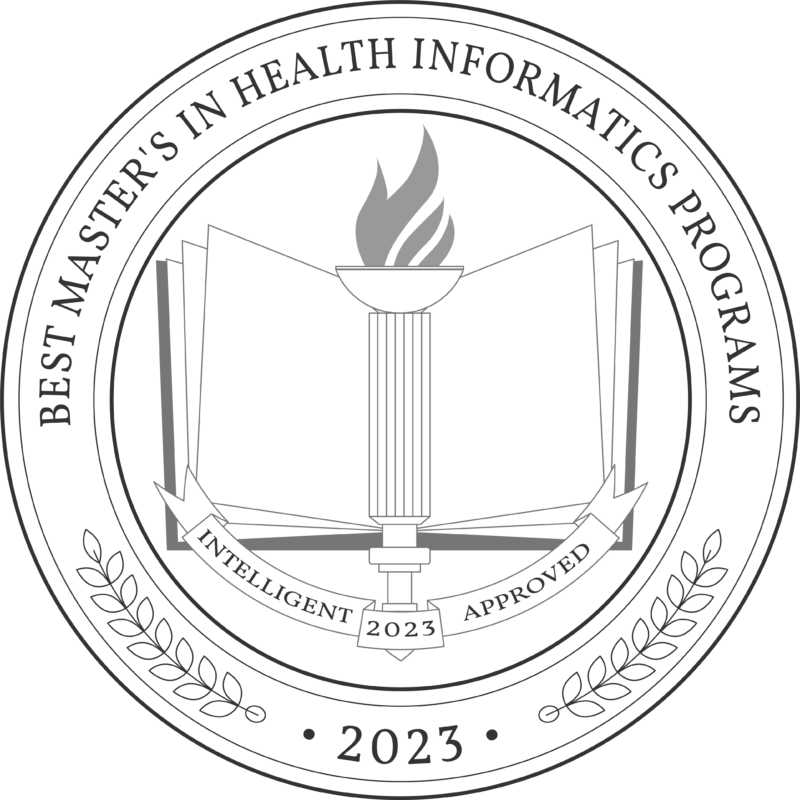
A 2023 Intelligent.com ranking places HU’s MS Healthcare Informatics at 10th in the nation in traditional, hybrid, and online formats, putting it ahead of programs at Boston University, George Mason, Stanford, Rutgers, and many more.
Industry Highlights
Healthcare Informatics
This 15-semester hour certificate program in Healthcare Informatics prepares the student with the basics of healthcare informatics in order to function effectively as project champions for healthcare information technology implementations and other basic informatics functions. A student may complete this program as a non-degree graduate student or as a Master of Science degree-seeking student.
Philadelphia College of Osteopathic Medicine (PCOM) Partnership
Philadelphia College of Osteopathic Medicine (PCOM) and Harrisburg University have partnered to offer a dual PharmD/MS in Healthcare Informatics (PharmD/MSHI). Acceptance into PCOM’s PharmD program includes admission into the Online Masters in Healthcare Informatics program, which students may take after completing 1 year of the PCOM PharmD program. Eligible PCOM PharmD students and alumni will receive up to nine (9) transfer credits from PCOM towards completion of the Masters in Healthcare Informatics program.
Students must maintain a 3.0 or higher GPA in order to transfer PCOM credits.
PCOM Dual PharmD/MS Healthcare Program
- Complete the application for the Online Program. Apply here.
- Submit a professional resume.
- Request official transcripts, resume and any documents be sent to GradTranscripts@HarrisburgU.edu.
- Direct questions to PCOM@HarrisburgU.edu.
Executive Format
Students who wish to take the program in executive format (weekly classes online and on-campus one Saturday per month), should email PCOM@HarrisburgU.edu.
Program Courses
This program requires a total of 36 semester hours: 1) 15 semester hours from the core courses listed below, 2) 6 semester hours of experiential courses, and 3) 15 semester hours of Individualized Concentration courses. The semester hour value of each course appears in parentheses ( ).