Skip to content

KEY TAKEAWAYS

Mission Statement: The Forensic Science program is dedicated to providing a rigorous, science-centered curriculum reflective of real-world expectations in forensic science that integrates fundamental scientific principles, critical thinking, and hands-on laboratory experience. The program fosters ethical decision-making, effective communication, and experience-driven learning, equipping students to become competent professionals and leaders in forensic science through faculty mentorship, community partnerships, and experiential opportunities.

  • Led by expert faculty with real-world forensic experience.
  • Courses taught by professionals in law, psychology, pathology, crime scene investigation, toxicology, and other fields.
  • Research and case study projects tailored to student interests.
  • Dedicated on-campus crime scene facility for hands-on learning.
  • Strategic internship partnerships with local law enforcement and forensic agencies.
  • Experiential learning through mock trials and crime scene simulations.

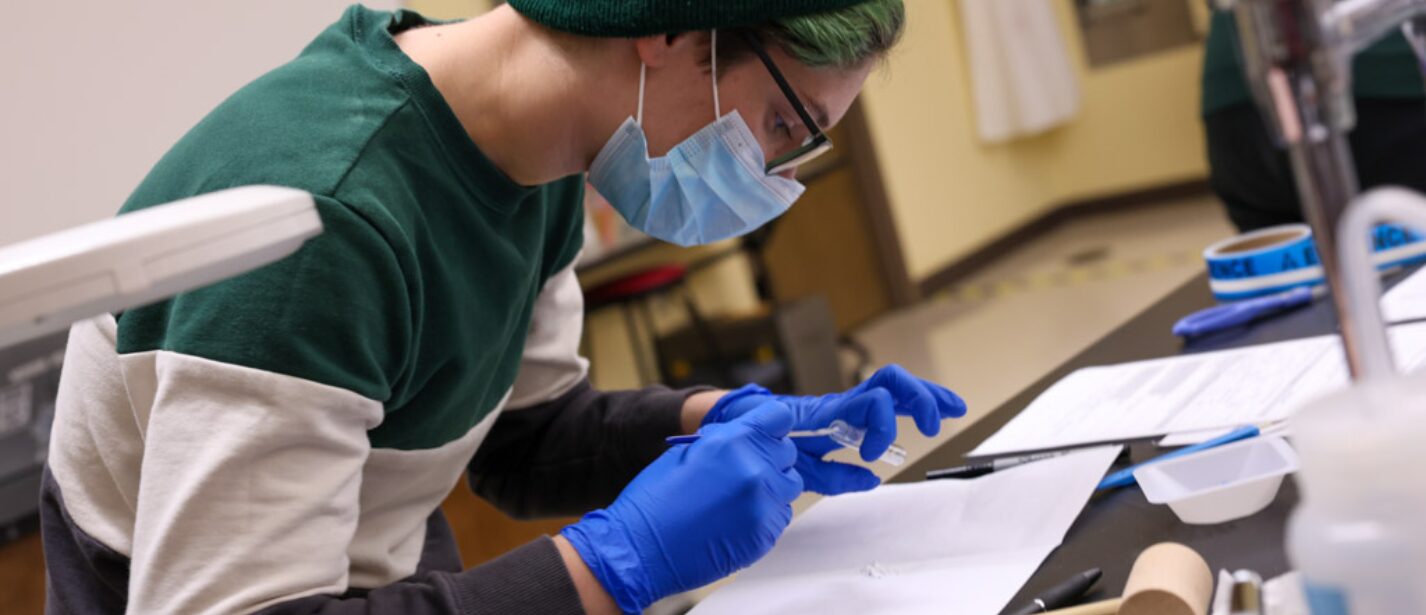
Each student enrolled in the Bachelor of Science in Forensic Science program completes case studies as part of the HU experience, gaining invaluable hands-on experience with industry-standard tools and investigative techniques used by today’s leading professionals. Students receive evidence and chain of custody and then choose the appropriate techniques, process the evidence, create an expert report, and testify to their conclusions, mimicking the role of forensic scientists in real casework.

Graduates of the program are well-prepared to enter the workforce as competent and ethical professionals ready to contribute to the advancement of forensic science. The curriculum emphasizes scientific and professional integrity, critical thinking, and hands-on experience to ensure students are career-ready and equipped to make meaningful impacts in laboratory, investigative, and research settings. Students pursuing careers in forensic science should be aware that background checks, drug screenings, and other site-specific requirements may apply to internships and employment opportunities in this field.

PROGRAM GOALS

From fingerprint, blood-spatter, and toxicology evidence analysis to anthropological fieldwork, students build practical skills and professional confidence while contributing meaningfully to the broader field of forensic science. Graduates of the B.S. in Forensic Science program will:

  • Obtain a thorough grounding in the natural sciences.
  • Build upon this background of natural sciences through a series of advanced studies.
  • Develop an appreciation of issues specific to forensic science through coursework and laboratory-based instruction.
  • Gain practical experience through a series of core competencies specific to the field of forensic science.

Program Concentrations

Forensic Chemistry

The Forensic Chemistry concentration offers a career-specific forensic curriculum, tailored to career ambitions that reflect real-world expectations and current practices within the crime laboratory. This concentration prepares students for careers in toxicology, drug chemistry, trace evidence analysis, and additional employment opportunities within the chemistry field and scientific testing laboratories. Mock cases – including evidence analysis, sample preparation, analytical instrumentation, quality assurance standards, and mock testimony – promote critical thinking skills, proficiency in evidence testing, and effective communication of case information.

Forensic Biology

This Forensic Biology concentration offers a career-specific forensic curriculum, tailored to career ambitions and goals that reflect real-world expectations and current practices preparing students for careers as aserologist, DNA analyst or forensic biologist. This concentration provides the opportunity for students to study biology in more depth, with specific applications to forensics and additional hands on experiences while meeting the highest standards in forensic education. Students are provided with mock cases to allow them the opportunity to analyze samples, review data, interpret results and testify regarding conclusions.

Crime Scene Investigation

The Crime Scene Investigation concentration offers a career-specific forensic curriculum, tailored to career ambitions and goals that reflect real-world expectations and current practices preparing students for careers in crime scene investigation, medico-legal death investigation, and additional employment opportunities within the criminal justice system. Mock crime scenes, physical evidence interpretation, analysis activities, mock testimony, and case studies promote critical thinking skills and effective communication of case information. Students will develop knowledge of law theory and practices that are fundamental to the field of forensics. Using mock crime scenes and evidence, students will demonstrate proper evidence collection, processing, documentation, and preservation.

INDUSTRY HIGHLIGHTS

The field of forensic science continues to expand as crime-solving techniques advance and incorporate new technologies. HU’s location in Harrisburg provides students with internship opportunities in both the public and private sectors. Depending on their concentration, graduates can pursue careers as forensic scientists, DNA analysts, toxicologists, latent print examiners, or crime scene technicians.


Program Courses

This program requires a total of 47 – 59 semester hours. The semester hour value of each course appears in parentheses( ).

FORS 225 – Legal Procedure (2 credits)

This course will provide an introduction to legal theory and procedure, legal terms including types of evidence admitted in court, admissibility of expert testimony, and the specialized drafting of an expert report which shall include a review and logical use of the evidence. The student will also experience the art of testifying. Offered Spring Semester, annually.

FORS 230 – Quality Assurance and Case Management (1 credit)

Forensic laboratory accreditation is critical in forensic science. Accreditation standards and recommendation from federal forensic science organizations will be discussed. The student will demonstrate an understanding of quality assurance and quality control procedures that are used within accredited forensic laboratories. Safety procedures, personal protective equipment (PPE), case management, and movement of the evidence through the crime lab will be discussed. Offered Spring Semester, annually.

FORS 250 – Forensic Photography (3 credits)

This course will focus on basic photography skills including different features available on a standard digital single-lens reflex (dSLR) camera and peripheral equipment such as digital flash, tripod and sync cord. The student will complete various activities on the fundamentals of forensic photography including composition, proper lighting, painting with light, scale reference and bounce flash. Photograph documentation of specific types of evidence such as fingerprints, bloodstain pattern, impression evidence and injuries will be discussed. Offered Spring Semester, annually.

FORS 270 – Crime Scene Investigation (3 credits)

This is a fundamental course in forensic death investigations. The areas of specialized focus include the causes, manner, physical circumstances, and mechanisms of both natural and unnatural deaths. Death scenes are examined and investigations reviewed, with evidence pertaining to how people die. In addition, the course looks at the various legal considerations and methods germane to concluding equivocal death determinations.

FORS 298 – Project I (3 credits)

This first project in the student’s experiential program challenges the student to identify, investigate, and analyze a particular topic in the program of study or a concentration. A key objective is to apply skills, methods, and knowledge obtained in prior courses with independent thinking and research; the final product represents the successful and purposeful application of knowledge. The project is undertaken with the close mentorship of a faculty member and may involve a community partner. Projects can involve scientific-based research or laboratory experiences, needs analysis or development plans for external organizations, or market studies and business plan proposals. Offered as needed.

FORS 315 – Forensic Entomology (4 credits)

This introductory course in forensic entomology will familiarize the student with the identification, recovery, and analysis of various insects associated with forensic investigations. The student will learn how to identify and understand the life cycles, morphology, and behavior of flies and beetles commonly associated with medicolegal death investigations. General entomology and insect morphology, recovery methods, and evidence collection will be discussed. Additional topics include insect succession, processing and identifications of insects, techniques for the estimation of the postmortem interval, entomotoxicology, patterns of decomposition, and environmental considerations.

FORS 320 – Forensic Pattern Analysis (3 credits)

This course will provide the student with an overview of the principles and concepts required for the analysis of pattern evidence through lecture material and laboratory experiences.  Methods of analysis for various types of forensic pattern evidence including fingerprints, footwear impressions, tire marks, tool marks, questioned documents, and fired bullets and cartridges will be discussed in addition to the necessary documentation and interpretation. The student will be able to apply their knowledge by analyzing evidence in laboratory activities and mock cases.

FORS 325 – Forensic Toxicology (3 credits)

This lecture/laboratory-based course will provide the student with an overview of the principles and concepts of forensic toxicology. The student will be exposed to pharmacology before learning the key topics in forensic toxicology. The lectures will introduce the student to various drug classes including central nervous system depressants, stimulants, and psychotics. The student will learn the use and abuse of these drugs along with their effects on the human body. Offered Spring Semester, annually.

FORS 330 – Forensic Instrumentation (3 credits)

The student will discuss and complete hands-on activities mocking actual casework. Scientific instrumentation and sample preparation will be discussed for a variety of samples commonly analyzed in forensic chemistry and biology. A specific focus will be on the theory, sample considerations, use of instrumentation, controls and standards, limitations, and documentation.  Two hours of lecture, three hours of laboratory per week. Offered Spring Semester, annually.

FORS 340 – Forensic Biology (3 credits)

This lecture/laboratory-based course will provide the student with an overview of the principles and concepts of forensic biology. The student will be exposed to serology and DNA analysis as it applies to forensic science. The lectures will introduce the student to the basis of biological evidence including both the techniques to identify various biological fluids as well as the methodology required to analyze it. Select activities will be completed to introduce some of the forensic biology lab work that accompanies the material learned in the lectures. Offered Fall Semester, annually.

FORS 345 – Drug Chemistry (3 credits)

Drugs, substances, and certain chemicals used to make drugs are classified into categories or schedules depending upon the drug’s acceptable medical use and the drug’s abuse or dependency potential. This course will explore Controlled Dangerous Substances (CDS) as defined within the Controlled Substance Act (CSA) of the United States. Different CDS classifications will be discussed including their origins, synthesis, pharmacological effects, and chemical structure, and properties. This course will teach hands-on wet chemistry and analytical instrumentation methods. Offered Fall Semester, annually.

FORS 350 – Trace Evidence Analysis (3 credits)

The student will utilize microscopy, perform chemical analyses, and interpret analytical data to determine the identity and/or probative value of evidence recovered during the commission of a crime. This course will address a variety of evidence, specific instrumentation, and analytical processes. Topics will include gunshot residue analysis, fiber, glass and paint comparisons, low explosive identification and polarized light microscopy. Offered Spring Semester, annually.

FORS 365 – Crime Scene Management (3 credits)

This course provides a practical introduction to criminal investigation and reflects the most recent investigative techniques and technology. The course outlines the fundamentals of inquiry and detail each element of an investigation. The course covers from the outset of an investigation, case preparation, and prosecuttion. Offered as needed.

FORS 455 – Crime Scene Management (3 credits)

This course offers the student advanced knowledge and training in crime scene investigation, resource management, and coordination of various complex crime scenes. The student will learn personnel management considerations for security and safety, theory, and investigation, as well as workplace resilience, cognitive bias, and management of potential occupational stress or hazards specific to the position. Event-specific investigations and complex scenes will be analyzed, and the student will design and evaluate action plans and outcomes.

FORS 362 – Medico-Legal Death Investigation (3 credits)

This course is a study of the process known as medico-legal death investigation. The course introduces the student to the legal systems surrounding the investigation of the cause and manner of death. The role of forensic pathology and the application of pathology to law are studied in relation to crime scene investigation. Natural, accidental, homicide and suicide deaths are explored in the perspective of the forensic pathologies.

FORS 368 – Forensics Anthropology (3 credits)

Forensic anthropology is a science applied to law which focuses on the identification of remains, human or non-human, that are beyond recognition due to decompositional changes and are more or less skeletonized. Osteology is the study of bone. The student studies basic human skeletal anatomy involving the axial and appendicular skeleton. The student uses that knowledge in osteology to determine sex, age, stature, and ancestry of unknown individuals. The student is then able to apply knowledge to casework and have a general understanding of forensic anthropology laboratory practices.

FORS 380 – Special Topics in FORS (3 credits)

This course covers topics in forensic science. It is an in-depth study of a selected specialized area and the content varies by semester.

FORS 385 – Advanced Crime Scene Interpretation (3 credits)

This course offers advanced knowledge in crime scene interpretation and reconstruction of physical evidence and specialized crime scenes.  The student will explore concepts, science-based principles, and interpretation considerations for physical evidence that may offer investigative information, scene activity, and/or the sequence of events at a crime scene.  Topics will include bloodstain pattern analysis, shooting and accident reconstruction, and fire, explosive, and hazmat investigations.

FORS 390 – FORS Directed Study (0 credits)

This course is designed for the student who demonstrates an interest in an area of study not offered or who wishes to pursue a discipline in greater depth than possible through existing courses. A directed study counts as an elective and may not be used for accelerated or remedial credit. A learning contract between the student and instructor defines the responsibilities of the parties and specifies the learning objectives and standards for successful completion of the project. A calendar of meeting times and deadlines shall be a part of that contract.

FORS 498 – Project II (3 credits)

This project must be in the student’s program of study or concentration. It should demonstrate application of the skills, methods, and knowledge of the discipline to solve a problem or answer a question representative of the type to be encountered in the student’s profession. As with Project I, this is undertaken with the close mentorship of a faculty member and may involve a community partner. The ideal project has a clear purpose that builds directly upon the learning that occurs within the student’s first project and internship. Offered as needed.

Program and Concentration Enrollment

Academic YearNumber of Full-time Enrolled StudentsConcentration Enrollment
2023-2415Forensic Chemistry (1); Forensic Biology (4);
Crime Scene Investigation (9); Undecided (1)
2024-2512Forensic Chemistry (5); Forensic Biology (2); Crime Scene Investigation (5)
2025-2622Forensic Chemistry (2); Forensic Biology (7); Crime Scene Investigation (13)

Career Outcomes & Student Success

Academic YearNumber of graduatesGraduates with job offers (180 days post-graduation)Graduates admitted into advanced degree programGraduates who were unreachable or did not respond
2023-24131021
2024-255401
2025-263N/AN/AN/A

Student Internship Locations:

  • ALS Environmental
  • Anne Arundel County State’s Attorney’s Office
  • Bennie Smith Funeral Home
  • Caring Gestures Home Healthcare
  • Dauphin County Coroner
  • Dauphin County Criminal Investigation Division
  • Harrisburg Area Community College
  • Harrisburg Bureau of Police
  • Harrisburg Police Department
  • Harrisburg University of Science & Technology Forensics Lab
  • Hooper Memorial Home, Inc.
  • Lower Paxton Township Police Department
  • Nashua Police Department

Capstone Project Topics:

  • Forensic Case Study – Crime Scene Investigation, Drug Chemistry, Trace Analysis – Ignitable Liquids
  • Forensic Case Study – Crime Scene Investigation, Firearms, Physical Match
  • Forensic Case Study – Crime Scene Investigation, Footwear Analysis, Physical Match
  • Forensic Case Study – Crime Scene Investigation, Hair Analysis, Bloodstain Pattern Analysis
  • Forensic Case Study – Crime Scene Investigation, Pathology, Trace Analysis – Fibers (cut/torn)
  • Forensic Case Study – Crime Scene Investigation, Serology, and Bloodstain Pattern Analysis
  • Forensic Case Study – Crime Scene Investigation, Serology, Toxicology
  • Forensic Case Study – Crime Scene Investigation, Toolmark Analysis, Questioned Documents
  • Forensic Case Study – Drug Chemistry, Toxicology, Pathology
  • Forensic Case Study – Fingerprint Analysis, Footwear Examination, Bloodstain Pattern Analysis
  • Forensic Case Study – Fingerprint Analysis, Trace Evidence, Serology
  • Forensic Case Study – Firearms Analysis, DNA, Serology
  • Forensic Case Study – Firearms Analysis, Pathology, Bloodstain Pattern Analysis
  • Forensic Case Study – Firearms Analysis, Questioned Documents, Gunshot Residue Analysis
  • Forensic Case Study – Pathology, Bloodstain Pattern Analysis, DNA Analysis
  • Forensic Case Study – Serology, Nuclear DNA, Mitochondrial DNA Analysis
  • Forensic Case Study – Toxicology, Drug Chemistry, Entomology
  • Forensic Case Study – Pathology, Physical Match, DNA