HARRISBURG, PA — Harrisburg University of Science & Technology (HU) is celebrating 25 years! When it was incorporated in the Commonwealth of Pennsylvania on December 12, 2001, HU became the only new STEM-focused university to have opened its doors in Pennsylvania in over a century.
To kick off 2026, as we look ahead to the official anniversary of Harrisburg University, let’s first take a look backward in time.
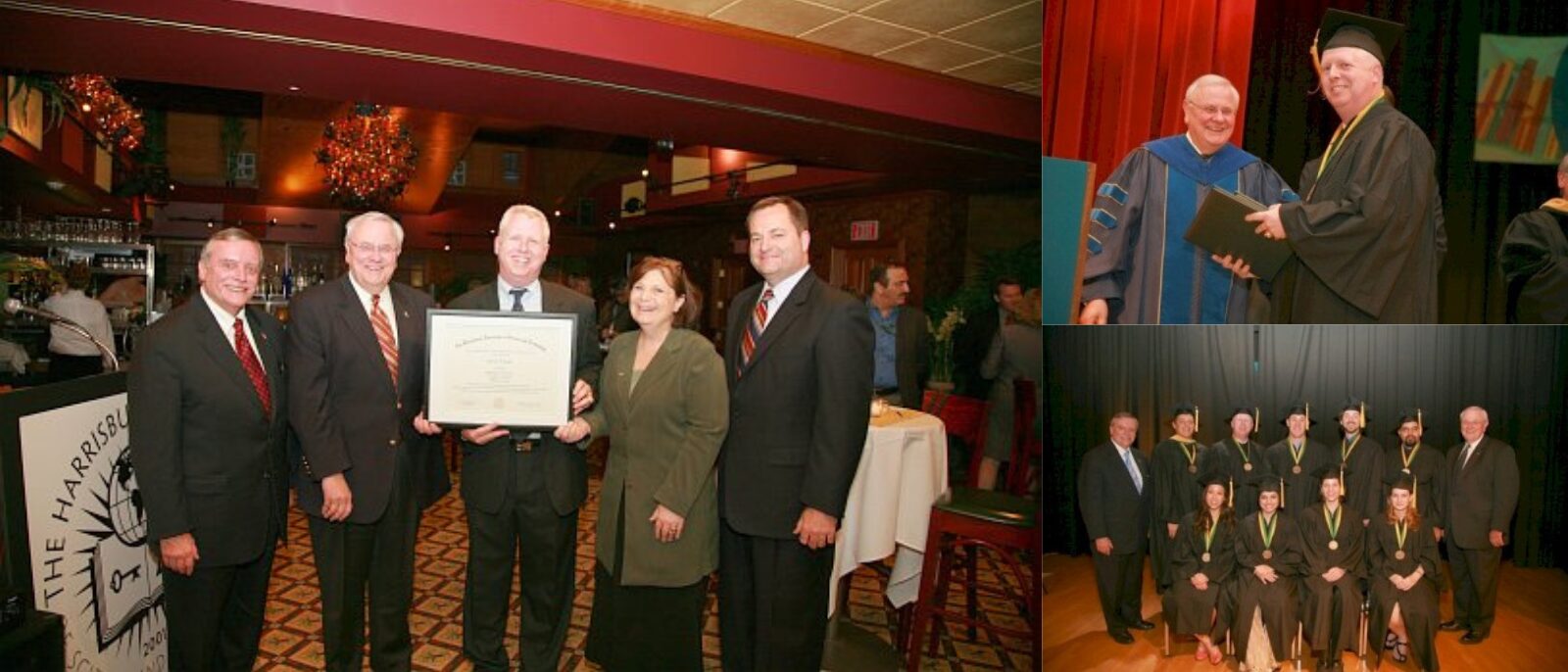
Before HU existed in its current form, students met for classes on the second floor of the local train station or in Strawberry Square. One of the earliest pioneers to arrive at Harrisburg University was Michael Wright, who became HU’s first-ever alumnus in 2006. Michael also served as a corporate faculty member at HU in the Information Systems Engineering & Management (ISEM) master’s program until 2016.
We sat down with Michael to reminisce about those early days, talk about what’s changed at HU – and what hasn’t – and find out how his time here impacted his life and career. Thanks for speaking with us, Michael!
You can watch a video snippet of Michael’s interview here:
It’s been a few minutes since you graduated from Harrisburg University. Could you tell us what you’ve been up to since then?
Since I graduated, I went to work with the federal government for an organization called Defense Information Systems, helping to define policies that were incorporated into cybersecurity initiatives. After that, I worked at IBM for a couple of years, followed by professional consulting for a software company. Currently, I’m working for a company called Owens & Minor out of Virginia. And for a short stint, I was a full-time faculty member here at the university.
When you first enrolled at HU, the institution was still untested and very new. What made you take that leap of faith, and what did it feel like to be a pioneer at a very new university?
It came down to the fact that I lacked a few credits to finish my degree. My wife was working here at the time, and I was very impressed with the faculty I met: their credentials and their personalities. I thought hard about it and realized I could finish my degree here.
It was probably the best decision I made, because the faculty were tremendous. They were very supportive and did everything they could to support their students. Even as an adult learner, they made sure we were fully supported.

Can you paint a picture of what the facilities and campus atmosphere were like when you studied here? What stands out from those early days?
It was a time when the university was growing. This academic center was still more of a concept than a finished building, and construction was ongoing while I was attending. That didn’t delay any of the courses I took. I remember taking chemistry with Christina Dryden, psychology, entrepreneurship – courses that were outside my comfort zone. The faculty were incredibly challenging. Even in the early days, it wasn’t a situation where the university was new and therefore grading lightly. Every student had to work for their grades. Nothing was handed out; students were challenged from the very beginning.
What major or academic track did you choose, and what attracted you to that field of study?
The degree that best suited me for completing my program was Integrative Sciences [now Biochemistry, Biology, and Chemistry]. I already had a lot of mathematics, computer science, and IT coursework. The advisors said I needed diversity beyond cybersecurity and information technology, so I took chemistry, psychology, entrepreneurship, a senior capstone, and a junior project. It was a diverse mix.
Were there any assignments, projects, or moments that felt especially innovative, given how new the university was?
The two that stood out most were the junior project and the senior capstone. For my junior project, I proposed writing a book on cybersecurity based on the field I was working in. That proposal ultimately led to me getting published in 2009, based on the concept I developed in 2005. It was extremely gratifying to see a classroom project turn into a published work tied to my federal government work.
The senior capstone was similar: I tied my work defining cybersecurity policies for the government directly into the project. Both were fulfilling and challenging. Professors like Joe Cannon pushed me to ask why I wanted to pursue these ideas and to challenge myself to aim higher.

Were there faculty members who played a major role in your experience?
Yes! Christina Dryden, Rob Fury, and Joe Cannon come to mind. As an adult learner coming back after 20 years away from a traditional college environment, I had to return to research mode and study habits. They guided me toward asking better questions and encouraged me to stretch academically. Chemistry with Christina Dryden was particularly memorable – I hadn’t taken chemistry in over 20 years, and it ended up being both challenging and fun. The professors didn’t just transfer knowledge; they helped students appreciate what they were learning so they could use it after graduation.
You have the distinction of graduating as HU’s first alumnus. How did your HU experience prepare you for the career chapters that followed?
I go back again to the junior project. At that time, I was just starting out with the federal government, and the project let me take what I was doing there and develop it into something more formal. Having the support of the faculty – and Joe Cannon in particular – made a huge difference. It began as a pipe dream. I never thought I would get published, but I stayed in contact with Joe after graduating, letting him know that publishers were interested. That drove me to push further, and that really comes back to the university.
At that time, HU only had a couple of physical locations, including the train station and other rented spaces. What was that like?
We taught and learned wherever space was available. I taught classes in Strawberry Square and took classes in the train station. This building was still being developed, so everything was spread out. It was a challenge, but it was also fun. We got to see the university being built literally from the ground up. And despite the scrappy environment, the learning didn’t suffer at all.
As you’ve watched HU grow from a handful of programs to a full STEM university with statewide and national partnerships, what changes feel most significant?
I’ve loved seeing the university evolve in its diversity, especially with international students. When I taught here, we had a true melting pot of students from all over the world, not just Pennsylvania. I’ve also been impressed by the growth in academic programs. We’ve gone from a few disciplines to offering programs that the country truly needs – nursing, cybersecurity, advanced STEM fields. Employers today struggle to find qualified applicants in science, technology, engineering, and math. HU is producing graduates who are filling those roles.

What advice would you offer to HU students today, or to future pioneers who will shape the university over the next 25 years?
Don’t be afraid of failure! Failure can spur innovation and push you to challenge yourself, think better, and ask better questions.
Is there anything about the HU community that you think has stayed remarkably consistent since your time here?
It’s the faculty. From the very beginning to today, the faculty have always put students first. Their love for the university and for the success of their students has never changed. They support students, see them succeed, and celebrate that success with them.
ABOUT HARRISBURG UNIVERSITY
Harrisburg University of Science & Technology (HU) is an independent, nonprofit university offering demand-driven degrees in advanced manufacturing, engineering, robotics, nursing, cybersecurity, and other critical fields. Accredited by the Middle States Commission on Higher Education, HU serves a diverse student body through undergraduate, graduate, and doctoral programs that link learning and research with practical applications. For information about HU’s affordable STEM degrees and professional development programs, call 717.901.5146 or email Connect@HarrisburgU.edu. Stay in the know by following Harrisburg University on LinkedIn, Instagram, and Facebook.
# # #