Advance the future of industry with hands-on experience in robotics, 3D printing, smart factories, and more.
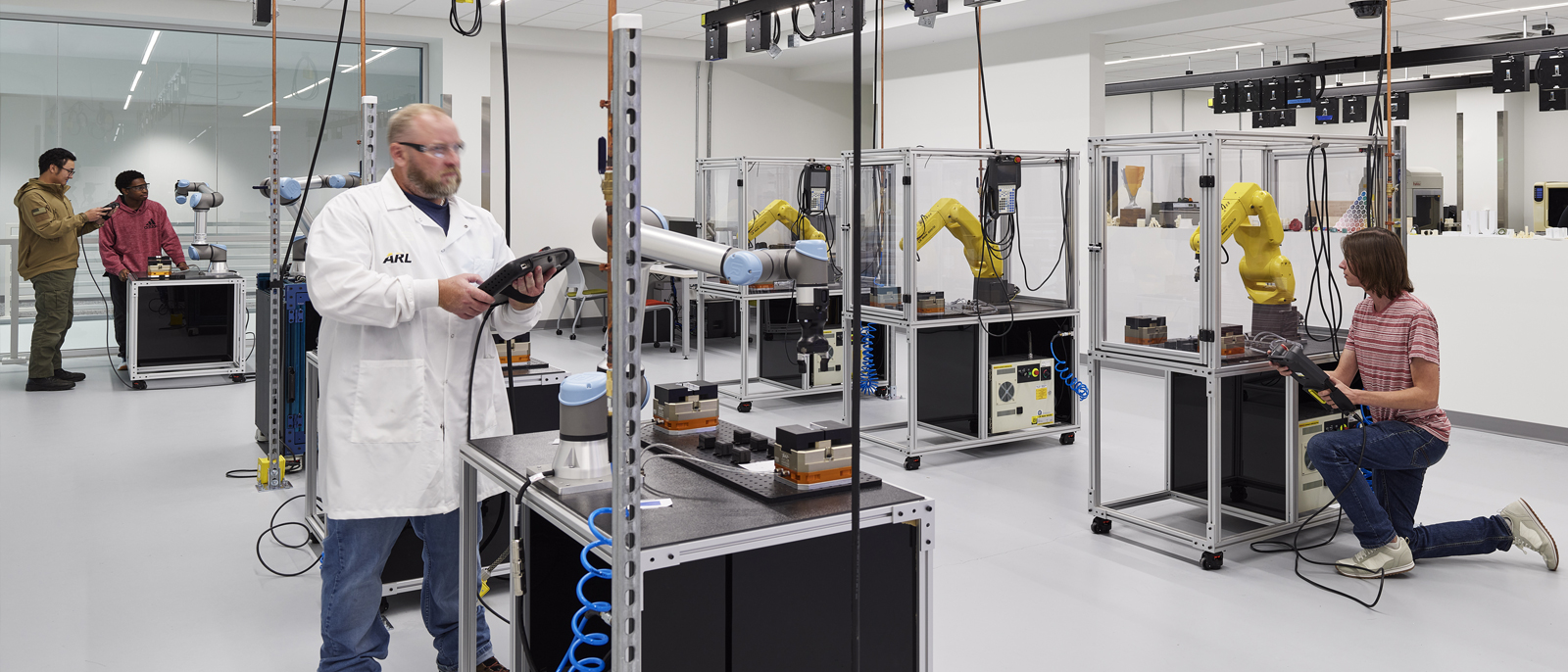
Harrisburg University’s BS in Advanced Manufacturing & Robotics is the only dedicated four-year program of its kind in the US, offering an immersive, technology-driven education that prepares students to lead innovation in modern manufacturing. With state-of-the-art labs, a full-scale smart factory, and strong industry partnerships — including NASA, Haas Automation, Phoenix Contact, Phillips Corporation, LuxCreo, and others — our students graduate with real-world skills and experience.
The only 4-year bachelor’s degree in advanced manufacturing in the US.
Hands-on curriculum featuring robotics, automation, machining, and 3D printing.
Full-scale smart factory with advanced robotic platforms (UR, Fanuc, Yaskawa).
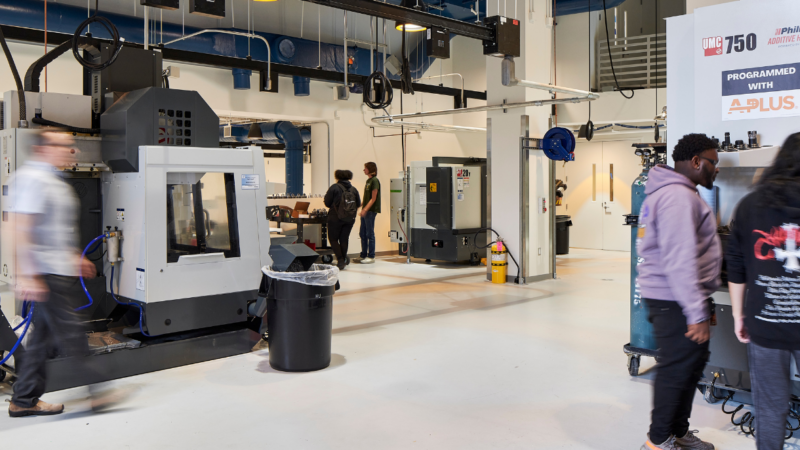
One-of-a-kind lab with 10+ industrial-scale 3D printers.
Real-world projects, including NASA’s Lunabotics Challenge.
Industry events like ADMA Day for high school outreach and engagement.
Internship pipelines with local and national manufacturing partners.
Program Goals
In order to achieve and reinforce the program goals (listed below), the following capabilities are provided at HU: Robotics & Automation, Additive Manufacturing (3D Printing), Subtractive Manufacturing (Machining), CAD/CAM & Simulation, Metal Working, Composites Fabrication, Polymer Processing, Materials Testing & Finishing, Electronics & PLC Programming, Factory Design & Programming in a CIM/FMS environment, Augmented & Virtual Reality, and various software solutions which connect these technologies to the manufacturing floor.
Graduates of the ADMA program will be able to:
Identify issues and design simple or complex manufacturing solutions.
Communicate technical findings in professional formats.
Collect, analyze, and interpret industrial and research data.
Analyze and evaluate metallic and non-metallic materials.
Develop solutions that reflect global awareness and ethical responsibility.
Integrate emerging tech in production environments.
Lead innovation in diverse manufacturing sectors.
As part of the Advanced Manufacturing program, the student completes a professional portfolio as a means for assessing learning outcomes and enhancing personal and professional development.
Industry Highlights
Advanced Manufacturing (ADMA) is the integration of manufacturing with robotic and digital technologies which enables the development and/or modification of new and existing parts/products/materials. This integration (currently slated as Industry 4.0 but moving towards Industry 5.0) allows for improvements in manufacturing processes with the use of state-of-the-art software and hardware tools that foster investigation, discovery, design, engineering, and development for those interested in robotics.
Advanced manufacturing (ADMA) plays a vital role in enhancing industries by improving reliability, productivity, and sustainability. The field spans multiple sectors, including:
Automotive
Aerospace
Electronics
Healthcare & medical devices
Food & beverage
National defense
Textiles & consumer products
Our ADMA students at Harrisburg University gain hands-on experience through project-based learning and real-world collaborations. Students have previously secured internships and full-time employment at innovative regional and national employers, including Ashland Technologies, BAE Systems, JLG Industries, KVG, LuxCreo Chicago, Microchip Technology, Mid-Atlantic Machinery, Nucor Skyline, Phoenix Contact, Whiting-Turner Contracting Co., and Wolfgang Confectioners.
Program Courses
This program requires a total of 47 semester hours. The semester hour value of each course appears in parentheses ( ).
This course provides fundamental computer literacy skills for manufacturing students in a MS Windows environment. Productivity software applications such as Word, Excel, OneNote, Teams, and PowerPoint are utilized with an emphasis on manipulating data for personal and professional communication. These applications will be directed towards computer mathematics, engineering economy calculations, and preliminary research techniques.
This course introduces the concepts of manufacturing including perspectives on overview, designing, managing, and improving manufacturing operations and systems. An overview of how manufacturing processes have advanced from pre-industrial times through the present is discussed covering the agricultural revolution, industrial revolution (Industry 1.0-5.0), and information revolution. Other topics of discussion include manufacturing logistics (from materials handling inside the factory via warehousing to supply chain management), global awareness, and ethics in manufacturing.
This course uses the various tools and techniques for processing metallic materials as a vehicle for developing a solid foundation for the hands-on manufacturing activities and industrial safety fundamentals used throughout the Advanced Manufacturing curriculum. Concepts introduced include precision measurement and layout, material properties and handling, and the use of various hand tools and machinery used in metal fabrication. Completion of OSHA-approved safety training and consistent demonstration of safe and responsible operation of lab equipment is a required part of this coursework.
This course is an introduction to analog and digital electronics as it relates to advanced manufacturing through hands-on activities centered around building and logically troubleshooting circuits and devices. The concepts and theories will be covered in an industrial and or an advanced manufacturing setting. Use of instrumentation will be stressed with the application of problem-solving techniques.
The Computer-Aided Design (CAD) course introduces three dimensional solid modeling design skills for manufacturing – skills critical in modern manufacturing environments. Using industry-leading software packages, content stresses foundational skills in 2D modeling, 3D solid object modeling, blueprint reading, and computer-aided drafting. The student will learn to create objects and assemblies in the digital realm; read and accurately create useful technical drawings that enable accurate communication of design concepts and requirements; and learn about various roles that CAD software and related software packages play in the manufacturing lifecycle.
This course is the application of sophisticated computer simulation software for analysis of manufacturing operations, procedures and processes. The course includes an overview of server-based and cloud-computing applications to permit secure data sharing and collaborations in company partnerships. Team and individual projects with utilizing manufacturing simulation and data management applications will be applied and presented.
This course is an overview of the types of non-metallic materials, selection, destructive testing, processing and application of non-metallic materials including and not limited to natural, laminated, plastic, compounds and fluids provided through industrial based solutions. Lab activities, demonstrations and visitations may be utilized to reinforce concepts.
This solid modeling course utilizes parametric technology, rapid prototyping, and technical sketching, along with the application of product processes and the examination of the components/variables of good design. CAD solid modeling software will be utilized to create part models and assemblies in the course as well. Products are designed and analyzed for manufacturability, performance, and potential for profitability for a company. Oral presentations, patent searches and prototype development will be assigned and completed.
This course is the conversion of CAD resources into NC machine code for the production of metallic and non-metallic products while integrated with industrial robots. Robotics will be introduced with hands-on programming of industrial robots and include tasks such as pick-and-place, welding, palletizing, assembly, finishing and robot integration into advanced manufacturing facilities.
This course introduces economic analysis from an engineering/manufacturing and personal finance perspective involving cost concepts (i.e., total revenue, profit, etc.) as well as the time value of money concept with equivalence involves present, future, and uniform series cash flows. The student will learn how to handle various economic scenarios involving the evaluation of both single and mutually exclusive alternative projects/products utilizing present worth, future worth, annual worth, internal rate of return, payback methods, and cost-benefit analysis. In addition, the student will learn how to interpret job offer letters (i.e., salaries and benefit packages) such that they are prepared to understand their own financial situation/status as they start their career pathways in advanced manufacturing after graduation.
This course furthers the investigation into CNC programming with the usage of several CAD/CAM software platforms. In addition, advanced manufacturing topics such as Geometric Dimensioning and Tolerancing (GD&T), process planning, and Group Technology (GT) are explored. The student takes a deep dive into learning additional programming for multiple industrial robot platforms and explore related robotics & automation topics such as robot speed of movement & precision, selection of end effectors / mechanical grippers, robotics control
systems, and industrial logic.
This course in an introduction to advanced manufacturing techniques including setup, operation, maintenance, troubleshooting and use of current and advanced material processing machines and devices. A systems engineering approach will be used to analyze complex systems for functional requirement decomposition as well as boundary/interface identification and description. This course will also build to a student-driven proposal for a cohort project in the Advanced Manufacturing II class which demonstrates and reinforces the skills and knowledge acquired from multiple courses and projects throughout the ADMA curriculum.
This course is the application of a combination of digital and analog logic technologies that will lay down a framework from which programmable logic controllers are programmed. The concepts of inputs, outputs, relay logic and ladder logic will be addressed. Industrial robots and automated devices will be introduced, on-line as well as pendent programming to include tasks such as pick and place, finish application and device integration.
This course is the approach of using computers to control the entire production process utilizing closed-loop control processes, based on real-time input from scenarios. The student will totally complete the digitization of manufacturing scenarios into advanced manufacturing scenarios in this course by including the application of CAD/CAM techniques.
This course is the application of sophisticated computer simulation software for a complete analysis of manufacturing operations and processes for a cradle to grave evaluation. Ground up individual and team projects utilizing simulation software, active data collection and storage to refine the manufacturing process that is controlled while providing and implementing efficiencies.
This course is the application of the completed advanced manufacturing suite of resources, which will be applied to solve several different manufacturing issues/projects provided by manufacturing experts. Building upon experiences and skills acquired in prior coursework and projects, class cohorts will use a course project format to pursue a series of manufacturing challenges which demonstrate and showcase a variety of manufacturing techniques, cohort interests, and learning objectives. Results will then be analyzed and presented in a professional academic format suitable for a capstone undergraduate experience.