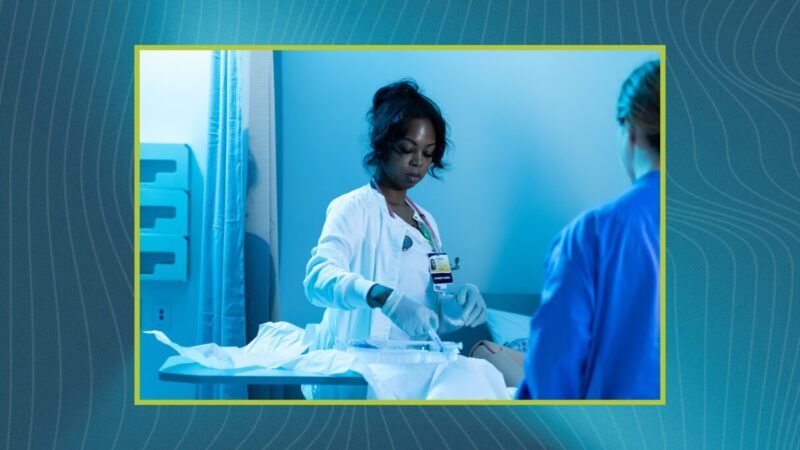
The 36-semester hour Master of Science degree in Nursing consists of advanced training in evidence-based practices, quality improvement, process improvement, and best practices in nursing education.

Complete in as few as 2 years

36 credit hours

100 hours of hands-on practicum required

Designed for working adults
About the MSN program:
Advance your nursing career and expand your impact on patients, communities, and the healthcare system through our Master of Science in Nursing (MSN) program. Designed for experienced nurses seeking to grow as leaders, educators, and advanced healthcare professionals, the program combines rigorous academic preparation with practical application.
With specialized tracks and a focus on leadership, evidence-based practice, quality improvement, education and innovation, our MSN program prepares graduates to meet the evolving demands of today’s complex healthcare environment and make a meaningful difference in the future of nursing.
The Master of Nursing is now a 14-week Executive Session format for domestic and international students
The program is designed to support improvements and innovations in nursing for the current American healthcare system. Course offerings in this program will give students a broad understanding of diverse topics in current trends in nursing. These include the promotion of evidence-based practice, the strengthening of interprofessional communication, and an overall mindset of professional development.
Accredited by the Commission on Collegiate Nursing Education (CCNE), the program will prepare nurses for careers in clinical and non-clinical healthcare settings.
MSN Student HandbookClinical Nurse Leader Track
Advance your nursing career and expand your impact on patient care with the Master of Science in Nursing (MSN) Clinical Nurse Leader (CNL) track. Designed for nurses who are ready to lead change, improve healthcare outcomes, and strengthen quality and safety across diverse clinical settings, this program prepares graduates to serve as influential leaders at the point of care.
Through advanced coursework in leadership, care coordination, quality improvement, evidence-based practice, and healthcare systems, students develop the knowledge and skills to transform patient care and lead interdisciplinary teams. Take the next step in your nursing career and become a catalyst for positive change as a Clinical Nurse Leader.
Nurse Educator Track
Inspire the next generation of nurses with an MSN Nursing Education track designed for nurses who are passionate about teaching, mentoring, and shaping the future of healthcare. This program prepares graduates with advanced knowledge in curriculum development, instructional strategies, assessment and evaluation, simulation, and evidence-based teaching practices.
Whether you aspire to teach in academic, clinical, or healthcare settings, the MSN Nursing Education track will help you develop the skills to become an innovative educator, leader, and advocate for excellence in nursing education. Turn your clinical expertise into a meaningful career that prepares tomorrow’s nurses for success.
Mission Statement
The Nursing Program at HU is committed to excellence in healthcare by providing high-quality professional nursing education and practice that addresses both local and global health needs. Guided by the principles outlined by Benner et al. (2010), the program employs a three-pronged apprenticeship model encompassing knowledge acquisition, clinical reasoning, and ethical practice. This approach prepares nurses to become leaders in clinical care and health system transformation.
Program Goals
A successful student of the program gains the following skills (vary according to the degree/concentration taken):
- Demonstrate collaboratory practice expected of all healthcare professionals;
- Produce a life-long learning plan specific to career advancement and maintaining credentials;
- Utilize evidence-based research to guide healthcare clinical and operation decisions;
- Generate frameworks required to implement healthcare initiatives; and
- Adhere to regulatory practices associated with the healthcare industry.
Additional Requirements for Admission to the MS in Nursing
The following are requirements in addition to those that are part of the general graduate admissions requirements:
- Completion of a bachelor’s degree in Nursing
- Transcripts from school that shows BSN Degree Completion
- Current United States issued RN License Number
- Harrisburg University complies with the laws of each state regarding the delivery of education to its residents. The MSN Nursing Program is currently accepting applications from residents of the following states: Alabama, Arizona, California, Colorado, Delaware, Florida, Hawaii, Idaho, Illinois, Indiana, Iowa, Maryland, Michigan, Missouri, Nebraska, New Jersey, Ohio, Pennsylvania, South Dakota, Vermont, Washington, and West Virginia.
- HU is not currently accepting applications from prospective students residing in states where the institution does not have state authorization. However, prospective students are encouraged to contact the HU Nursing program to obtain updates related to state authorization in additional states. Admitted students are also advised to monitor this page for any updates prior to relocating to another state, as this can have an impact on the ability to be placed for practicum field experiences. For states denoted with clinical field experience restrictions, HU does not have the necessary state authorization approvals to offer practicums of this kind in those states at this time.
The master’s degree program in nursing at Harrisburg University received its 10-year reaccreditation in March 2026 from the Commission on Collegiate Nursing Education.
Program Concentrations
CLINICAL NURSE LEADER
The clinical nurse leader concentration is designed for students with a passion for improving individual and populations’ health and well-being. Courses empower students to be a frontline leader and change agent utilizing best practices in nursing and science. Students also focus on developing, implementing, and evaluating quality and process improvement to achieve the desired outcome.
NURSE EDUCATOR
The nursing education concentration is designed for students with a passion for teaching and leading nursing peers in various settings. Students will learn innovative teaching methods, curriculum development, and evaluation techniques using evidence-based practices paired with population health practices.
Industry Highlights