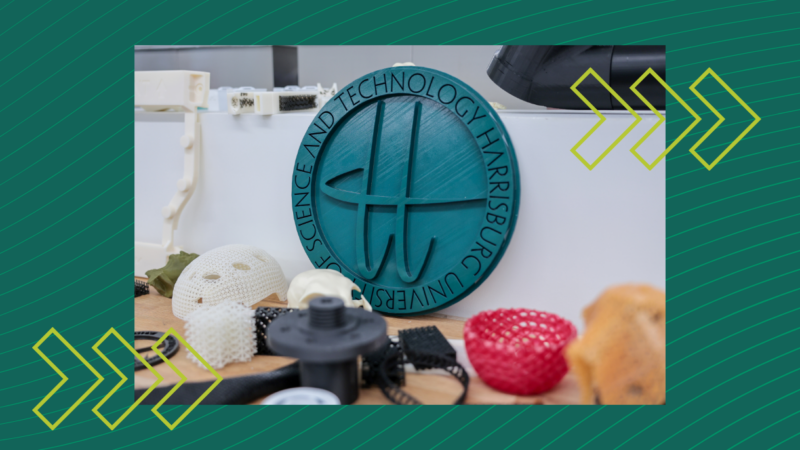
HARRISBURG, PA — From September 9–11, Harrisburg University of Science & Technology (HU) transformed into a hub for advanced manufacturing collaboration and coordination as leaders from academia, industry, and the armed forces converged for J-DAMMIT 2025. The Joint-Defense Additive Manufacturing Meeting for Innovation & Transition hosted over 400 attendees and featured 20 hands-on tech demos from partners and sponsors.
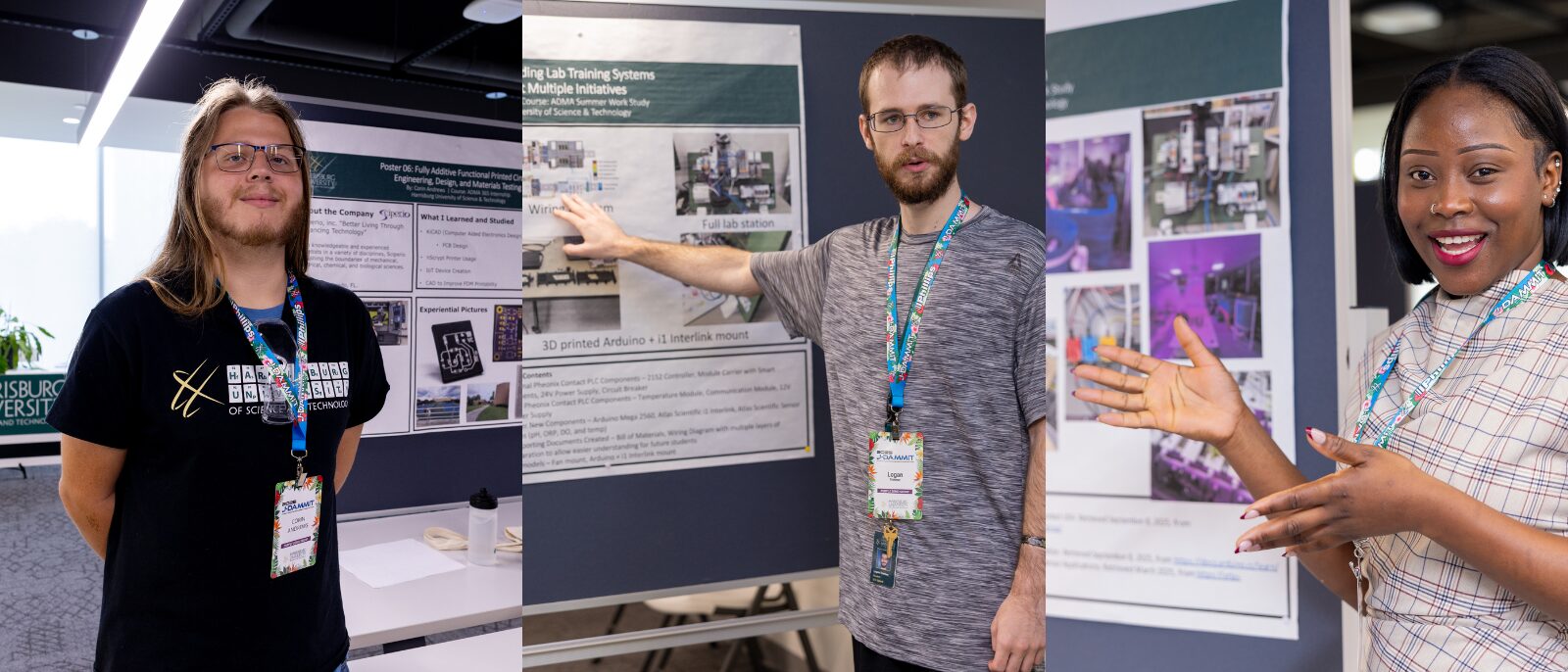
As befits a summit focused on innovation, J-DAMMIT 2025 featured a slate of student presenters and poster sessions from across HU disciplines. The degrees represented included Advanced Manufacturing, Engineering, and Mathematical Sciences, as well as input from Environmental Science and Biotechnology students.
The projects on display here represent some of the most promising emerging technologies, some of which could reinvent entire industries. From feeding humans on mars to perfecting controlled environment agriculture (CEA) and 3D printing automobiles at scale, these students aren’t just learning about the state of the art – they’re helping to define it.
Corin Andrews: Fully Additive Functional Printed Circuits Engineering, Design, and Materials Testing
Experiential learning sits at the heart of every HU degree program, with every Harrisburg University student completing an internship or applied research as a matter of course. For the 2025 J-DAMMIT student poster sessions, Corin Andrews, an Advanced Manufacturing & Robotics student, presented details about his recent summer internship.
“This summer, for my internship, I went down and worked for a company called Sciperio in Florida. I was originally introduced to this company because it’s closely associated with nScrypt and LJ [Holmes, Executive Director of HU’s STORMWERX Research Center] is on the board there. I did a lot. And I learned a lot! Some tasks I had to do regularly were electronics wiring, the design of electronics, lots of CAD, lots of 3D printing brackets, fixtures, many other things.”
He continued: “My favorite part was creating fully functional, additive-manufactured circuits. I also built a thermal test chamber and a lot of IOT [Internet of Things] devices. I had to learn how to use CAD design for PCBs, which house the microcontroller that you program, connected to a server that gathers data, also connected to power and to other devices like temperature sensors, humidity sensors, and current sensors. It was also fun to work with experimental materials. Some designs are only 100 microns wide. It’s all about operating at a super-small, very precise scale. The applications in electronics 3D printing are huge.”
3D-printed electronics, particularly at the micron scale, are innovative because they allow circuits and devices to be fabricated with unprecedented precision and complexity, as well as in novel form factors. This technology enables the integration of electronics directly into unconventional shapes, flexible materials, and compact devices, opening possibilities for wearable tech, biomedical implants, and compact sensors. Additionally, it can reduce material waste, shorten production times, and allow rapid prototyping, all of which accelerates the development of next-generation electronic systems.
Kadijatu Johnson ‘26: Aquaponics Automation
Kadijatu Johnson is pursuing a dual major in Advanced Manufacturing & Robotics and Engineering & Mathematical Sciences.
The H2HU Aquaponics Automation project focuses on upgrading and automating the aquaponics system in Harrisburg University’s Student Union to improve sustainability, monitoring, and efficiency. By integrating programmable logic controllers (PLCs), industrial sensors, and automation tools, the system can collect and analyze real-time data on key water quality factors such as pH, oxidation-reduction potential (ORP), dissolved oxygen, and temperature. Automation reduces the need for manual monitoring, increases accuracy, and creates a reliable, scalable framework for sustainable food production.
Aquaponics is a sustainable food production system that combines aquaculture (raising fish or other aquatic animals) with hydroponics (growing plants without soil) in a closed-loop environment. The fish produce waste that is converted by beneficial bacteria into nutrients for the plants, while the plants naturally filter and clean the water for the fish.
“To make sure the plants and fish are staying healthy, we are using these sensor chips,” said Kadijatu. “Now, whoever’s responsible, whether it’s scientists or growers, no longer has to do the calculations for these things by hand. Once the probes are connected, they’re able to collect real-time data that’s coming in directly from what’s happening.”
The project also has a humanitarian angle. “At the Steelton greenhouse [a joint effort by Harrisburg University and Steelton-Highspire High School], once the fish get too big or to the point where they’re no longer productive, they actually donate them to a soup kitchen downtown. I love helping people! Bringing nutritional resources to food deserts, like Harrisburg, means we’re doing good in our immediate environment, as well as advancing the science of aquaponics. I love it.”
As these automation tools come of age, expect to see them rolled out in greenhouses – as well as scaled-up, industrial-scale farming CEA facilities.
“We’re also replicating what we’re doing for future students,” concluded Kadijatu. “We’re going to be replicating 11 other boards for students so they can learn this, because we’re graduating and we want them to build on what we’ve done without starting from scratch. They’re going to be learning it in the regular PLC class that’s offered under program, and now they have a foundation to build on.”
Alexander Hang: Monolith Project – 3D Design of Oyster Hatchery
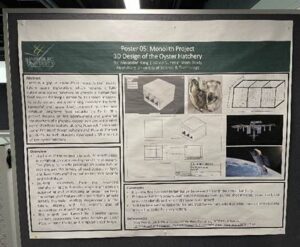
There is a gap in aquaculture research that could assist future space exploration, which requires a fully automated oyster hatchery to provide a sustainable food source for long-duration human space missions. As such, oysters are a promising candidate for both terrestrial and space food, intended to offer and establish long-term food security. This project focuses on the development and potential construction of a physical closed-loop and automated oyster hatchery system, utilizing Autodesk Fusion 360 computer-aided design software and Phoenix Contact products.
The focus of this student project is to assist Monolith Space in designing an automated system to raise oysters. The plan is to rapidly prototype an oyster habitat that ensures the survival of seed oysters, and feed them until they mature into their juvenile and adult stages.
Oysters build on the established science behind aquaponics, reinventing the concept for a bold future where more humans live and work off-planet. Oysters could be a better choice than fish in off-planet aquaponics systems because they are filter feeders that require no external feed, instead thriving on algae or microorganisms. They naturally clean and recycle water, reducing the need for complex filtration systems and maintenance. Oysters also produce nutrient-rich byproducts that can support plant growth, and their hardy physiology makes them more resilient to variations in water quality than many fish species.
The project was funded by Monolith Space and will continue to involve Harrisburg University Advanced Manufacturing students. The design will feature refinements that align with NASA’s Payloads Interface Requirements in the future, aligning with the project’s goal of prospective use in orbit or space. Both the International Space Station and Vast Haven-1 are potential orbital candidates to test the oyster hatchery system.
Logan Trimmer: The Efficacy of Hybrid/Additive Manufacturing for High-Stress Automotive Parts
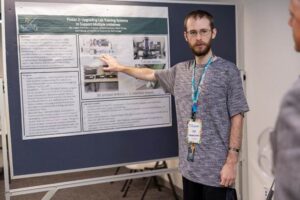
The goal of this research is to establish the viability of using hybrid manufacturing for automotive applications. By verifying that high-stress components can be created, it can be assumed that any other lower-stress part could be made to match the strength requirements. A limiting factor of adoption for hybrid manufacturing is how new the technology is. Studies on time, cost, strength, and scalability will be performed to allow for comparisons with traditional manufacturing technologies (casting, forging, milling) used in automotive applications. This research will be performed using a HAAS UMC 750 with a Meltio wire-arc direct energy deposition (DED) attachment).
For the project, the team began by removing a piston from a 6.5-horsepower pressure washer engine. The part was then 3D scanned and modeled in Fusion 360, followed by the printing of a plastic prototype to confirm that the model’s dimensions were accurate. Once the design was validated, a third party reviewed the file to confirm its printability and provide material recommendations for 3D printing.
To prepare for machining, a blank version of the model was created to allow for toolpath generation and finishing operations on a five-axis milling machine.
“Printing the blank took approximately 3.5 hours and cost about $18 in material,” explained Logan. “Compare that to round stock of a similar size, which would cost around $32 and could introduce additional delays due to shipping. “The cost savings are tremendous with this new method, from the cost of materials to the expenses of shipping and logistics.”
In many ways, Logan’s research – and all the projects explored here – exemplify the purpose of Harrisburg University. Every day, HU students examine problems and opportunities, focus their efforts on devising solutions, and then work with other students and the broader community to test, refine, and roll out these solutions.
“That’s the nature of our program. There’s always something hands-on, something with real importance or scale,” said Logan. “That aspect – taking part in large, tangible, hands-on projects, isn’t something you get with other programs or at other schools.”
Visit STORMWERX on LinkedIn to learn more about J-DAMMIT, view photos from the event, and read posts from attendees and exhibitors. To get in touch about sponsoring J-DAMMIT or partnering with STORMWERX, please visit HarrisburgU.edu/STORMWERX.
ABOUT HARRISBURG UNIVERSITY
Harrisburg University was recognized by US News & World Report as one of the nation’s most innovative colleges for 2025. HU is accredited by the Middle States Commission on Higher Education and is a private, nonprofit university offering bachelor’s and graduate degree programs in science, technology, engineering, mathematics, nursing, and other health science fields. For additional information about HU’s affordable, demand-driven undergraduate and graduate programs, please call 717.901.5146 or email Connect@HarrisburgU.edu. Stay updated by following Harrisburg University on LinkedIn, Instagram, and Facebook.
MEDIA CONTACT
Do you have questions about this story? Interested in lining up an interview? Please reach out to Dan Wilhelm, Communications Manager for Harrisburg University of Science & Technology, with all media inquiries.
# # #