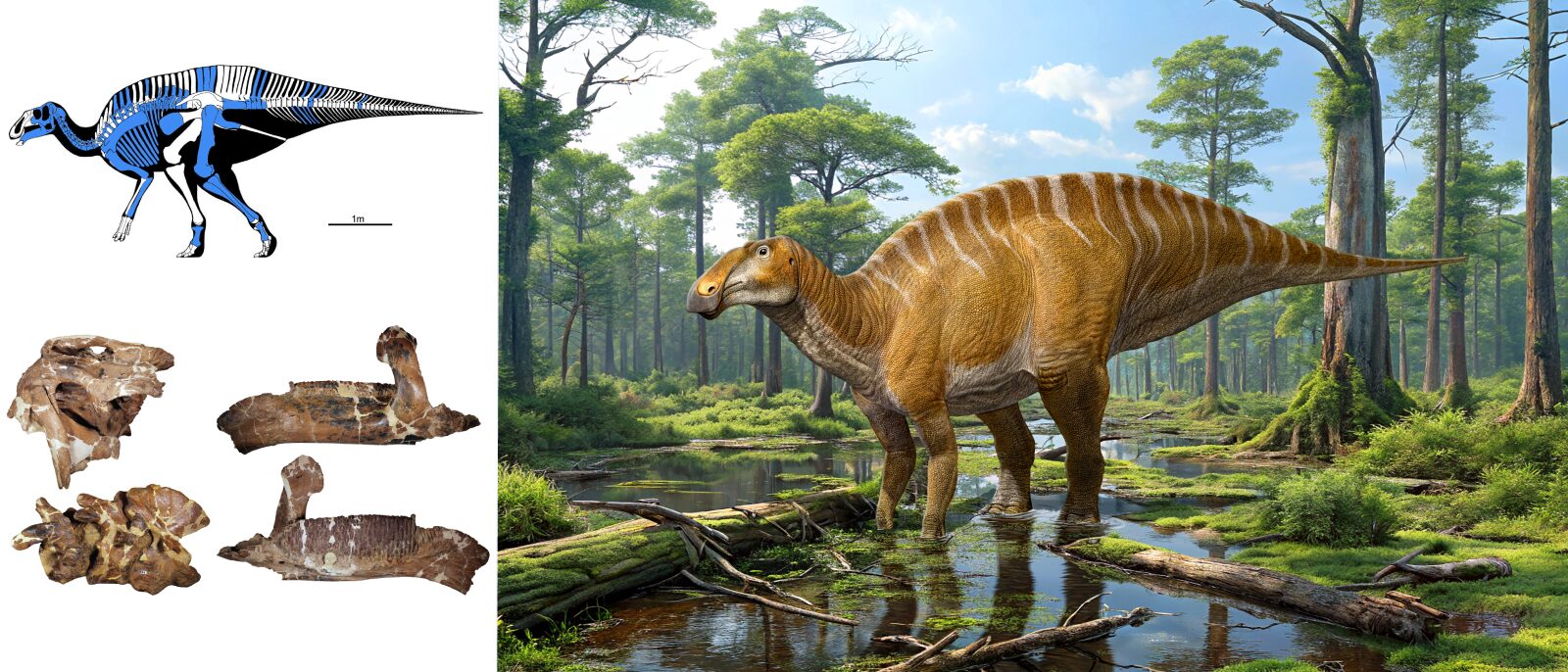
HARRISBURG, PA — A group of researchers, including Harrisburg University of Science & Technology’s (HU) Dr. Steven Jasinski, have recently named and described a new species of large hadrosaurid: a group of dinosaurs commonly called “duck-billed dinosaurs” related to others like Parasaurolophus and Edmontosaurus. Dr. Jasinski has participated in the naming and description of several new species of dinosaur in recent years.
Dr. Jasinski, of HU’s Department of Environmental Science & Sustainability, and researchers from several institutions in the United States and Slovakia, including the New Mexico Museum of Natural History & Science, Montana State University, Pennsylvania State University, and Pavol Jozef Šafárik University, named and described Ahshislesaurus wimani, a newly discovered duck-billed dinosaur from New Mexico that lived around 75 million years ago – several million years before well-known dinosaurs like Tyrannosaurus rex and Triceratops.
The team reported their findings in a paper publishing soon in the journal, “Bulletin of the New Mexico Museum of Natural History and Science.” The research team not only included Dr. Jasinski but also Sebastian Dalman (who Jasinski has worked with on several dinosaur projects), Spencer Lucas and Anthony Fiorillo of the New Mexico Museum of Natural History and Science (NMMNHS), Edward Malinzak of Penn State University, and Martin Kundrát of Pavol Jozef Šafárik University.
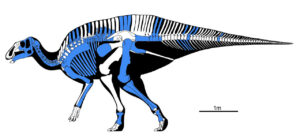
With its large body and flat, duckbill-shaped mouth, Ahshislesaurus wimani was a vital dinosaur for its ecosystem in New Mexico during the late Campanian age. Based on some of the fossil material, it could have grown to potentially 35 to nearly 40 feet long and weighed around 9 US tons.
Ahshislesaurus wimani is a fascinating new dinosaur collected from a famous fossil locality known for some other famous dinosaurs, including the horned dinosaur Pentaceratops. The locality, called Ah-Shi-Sle-Pah, was visited by the famous fossil collector Charles H. Sternberg in the early twentieth century, who collected many famous fossils, some of which were sent around the world to places like the Museum of Evolution at the University of Uppsala in Sweden.
The fossil bones that represent Ahshislesaurus wimani, identified as USNM VP-8629, were first discovered in 1916 in Late-Cretaceous rocks of the Kirtland Formation near Four Corners in Northwestern New Mexico. They were collected by the famous collector John B. Reeside, Jr., and sent to the United States National Museum of Natural History. The fossil specimen was first described in 1935 by the famous paleontologist Charles Gilmore, although he referred it to another hadrosaurid called Kritosaurus navajovius at the time.
Though it was originally referred to Kritosaurus, many fossils discovered previously are being re-evaluated due to more fossils and new data becoming available to researchers. In light of this new data, Dalman (the lead author of the new study), Jasinski, and their co-authors found distinctions between not only these fossils and Kritosaurus, but also all known hadrosaurids.
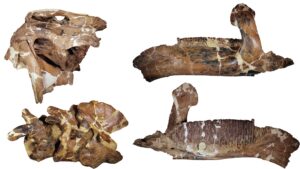
Some of these key features are present on parts of the skull of Ahshislesaurus, including aspects of the quadrate, jugal, and dentary. These characteristics help differentiate the new dinosaur from others already known and confirm its unique nature. There are other potentially distinct features from post-cranial bones, particularly within the ischium, a pelvic element, but these bones are not yet definitively referrable to the new species. New fossils with overlapping elements are needed to confirm or refute this.
The scientists also investigated the relationships among hadrosaurids, the family of dinosaurs commonly called duck-billed dinosaurs. They found Ahshislesaurus wimani to be part of a group of saurolophines, which includes other duck-billed dinosaurs from New Mexico, Texas, and Mexico. It suggests a group of related hadrosaurid dinosaurs was living and speciating in the region late in the Cretaceous period.
Other results from their analyses on the evolutionary relationships among hadrosaurids show numerous connections between Asia and North America, suggesting there were many migrations between these two continents in the Late Cretaceous, when they were connected by a land bridge in the north between present-day Alaska and Russia.
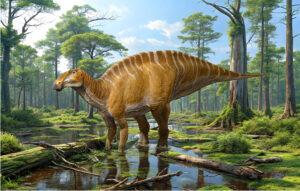
Ahshislesaurus wimani is part of a diverse fauna from the Late Campanian (Late Cretaceous) of northwestern New Mexico that is commonly called the Hunter Wash local fauna. The dinosaurs that are part of this fauna, and those Ahshislesaurus may have lived alongside, include chasmosaurine ceratopsids, ankylosaurids, hadrosaurids, pachycephalosaurids, and small and large theropods, including dromaeosaurids, ornithomimids, troodontids, and tyrannosaurids. The tyrannosaur Bistahieversor would have likely been the main large predator Ahshislesaurus would have been wary of.
The ecosystem of Ahshislesaurus was also teeming with non-dinosaur diversity, including freshwater chondrichthyans, osteichthyan fishes, frogs, salamanders, turtles, lizards, crocodylians, the pterosaur Navajodactylus, and mammals.
Even so, Ahshislesaurus was likely a major part of its ecosystem. “Hadrosaurs have sometimes been colorfully called ‘the cows of the Cretaceous,’ said Dr. Jacinski. “While this may not be a perfect metaphor, they likely were living in herds and would have been conspicuously present in the environments of northern New Mexico near the end of the Cretaceous.”
The American Southwest has been less well-studied than many areas farther north, like Montana and Alberta, and Jasinski and his fellow researchers are hopeful they will learn far more as more study occurs. While we have known about dinosaurs in the southwestern United States for around 150 years, we are learning more about the dinosaurs and other animals that lived there, and these fossils and species are helping scientists understand dinosaur evolution better as well.
However, there is some worry about the future of these resources. As more areas are sold to private hands, or less land is maintained by the government, there are fewer opportunities for people to find these fossils, which are the foundation for learning about life in the past and how life has become as diverse and wide-ranging as it is today.
“Paleontologists are having more and more difficulty conducting field work,” says Jasinski, who actively conducts field work to collect fossils. “The fossils themselves are the foundation, not just of paleontological research, but they provide the framework for our understanding of evolution and how life has reached the amazing varieties it has today. These fossils are what we need to learn about life, and they help give us ideas about how things may change moving into the future. These resources are key to our knowledge, and once they are gone, destroyed, or sold without any accompanying information, they can’t come back. There are likely an immeasurable number of fossils and fossil species that have been lost, and more will continue to be lost unless we work to preserve these resources and make them available to everyone through institutions like museums. I just hope we can save them before it’s too late.”
Jasinski and his team also hope to continue to find more fossils of not only Ahshislesaurus, but others as well. “Ahshislesaurus wimani is a captivating new dinosaur. The more we learn about these ancient animals, the more we realize there are so many more things to discover and learn. I can’t wait to learn more and teach others about this incredible world we are a part of.”
To read the team’s paper describing Ahshislesaurus wimani, feel free to contact Dr. Jasinski or the New Mexico Museum of Natural History & Science.
ABOUT HARRISBURG UNIVERSITY
Harrisburg University was recognized by US News & World Report as one of the nation’s most innovative colleges for 2025. HU is accredited by the Middle States Commission on Higher Education and is a private, nonprofit university offering bachelor’s and graduate degree programs in science, technology, engineering, mathematics, nursing, and other health science fields. For additional information about HU’s affordable, demand-driven undergraduate and graduate programs, please call 717.901.5146 or email Connect@HarrisburgU.edu. Stay updated by following Harrisburg University on LinkedIn, Instagram, and Facebook.
# # #