HARRISBURG, PA — When a group of high school students from the Pennsylvania Cyber Charter School (PA Cyber) arrived at Harrisburg University this summer, Professor Glenn Williams didn’t hand them a textbook. He handed them an empty factory.
The visit was part of PA Cyber’s annual three-day engineering camp, which combines hands-on projects, industry partnerships, and community engagement as students gain practical skills and insights into engineering careers and pathways. This year’s theme — “The World of Engineering and Amusement Parks” — brought campers to HU for a morning with staff and students from the University’s Advanced Manufacturing and Robotics program. The students explored the skills, educational pathways, and tools “used to help keep the thrills safe and exhilarating,” in the words of Kyle Walsh, STEM Education Coordinator for PA Cyber.
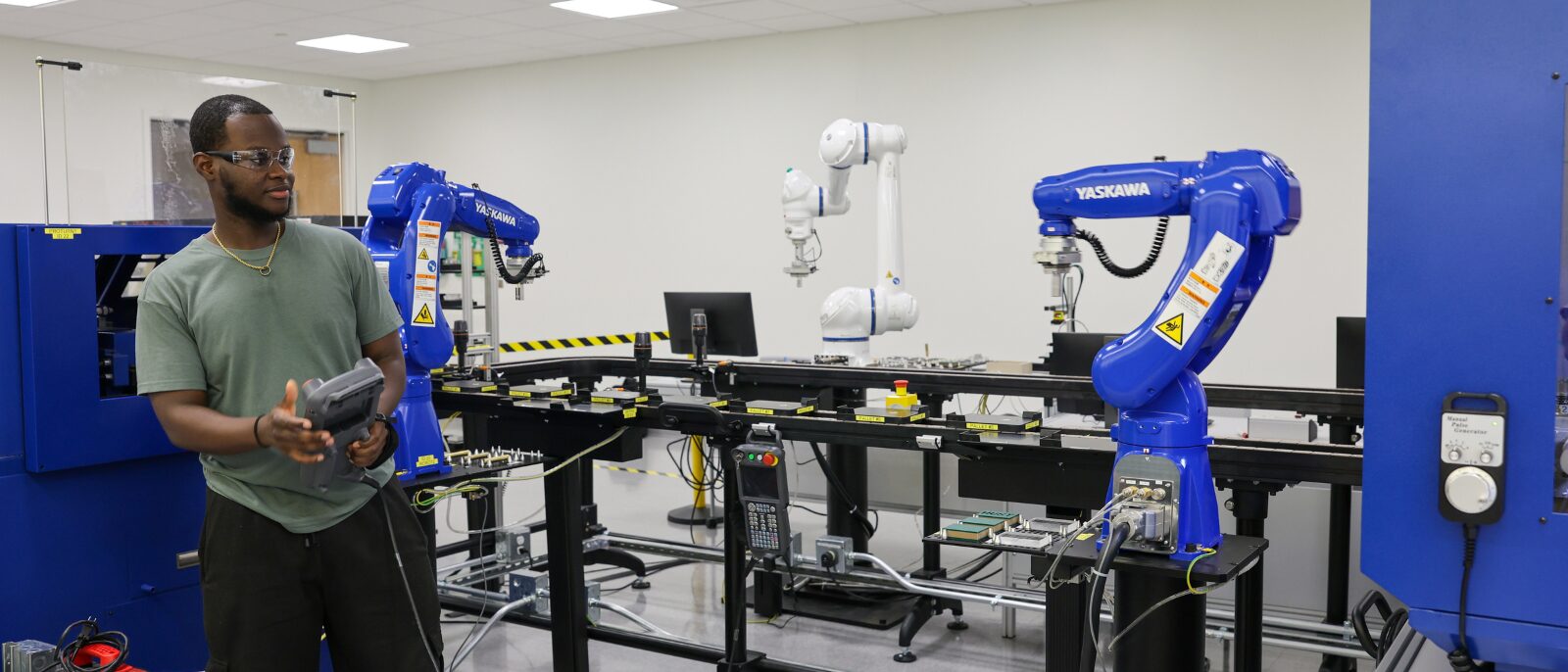
Using Factory IO, a 3D simulation platform for factories, Williams invited the students to imagine and then build an industrial facility of their own. It’s a central set of skills in HU’s Advanced Manufacturing degree: a distinctively hands-on, industry-partnered bachelor of science program.
“I wanted them to get comfortable with the idea that they can put equipment in an empty factory, then look at that equipment and make a distinction between a motor and a sensor — and a distinction between editing and running the simulation,” Williams said. “If you’re driving a car, you can’t put gasoline in the tank while you’re driving. If you’re going to design a factory, you can’t run the simulation at the same time.”
For Yaasiel A., a repeat camp attendee, that hands-on approach is exactly the draw. “Whenever we come here, we can touch the stuff,” she said. “It’s less theoretical — it makes it real. Real and practical.”
From Spidey Senses to Sensors
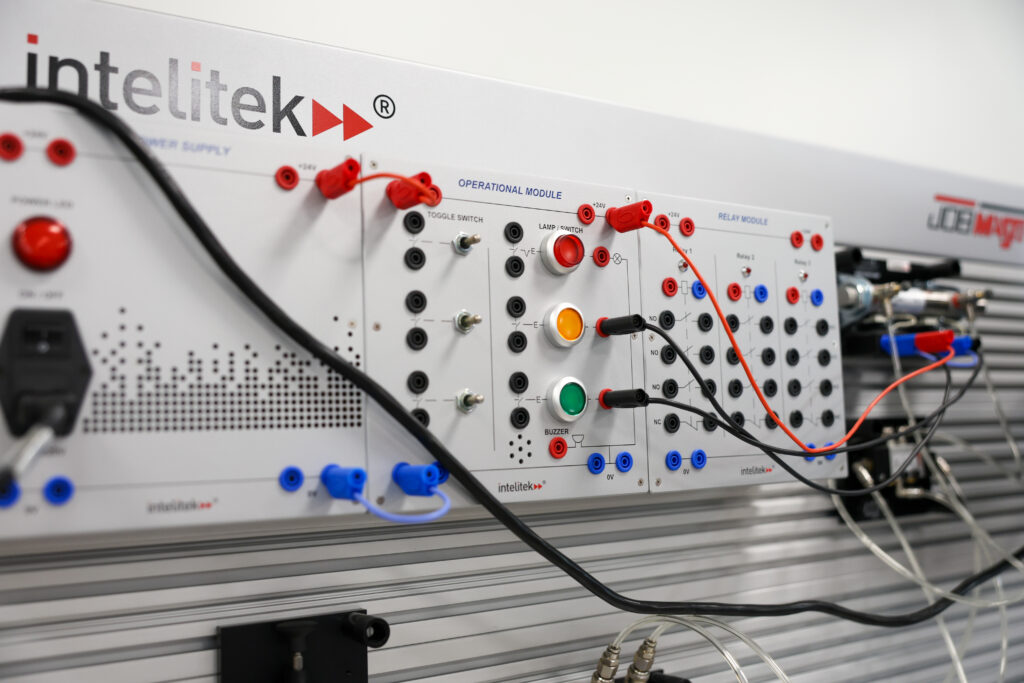
When Williams asked the students to explore the simulator’s sensors, they started with the sensors they knew best: their own.
“A person has five senses. So I asked: can you see five sensors in the factory? Then I asked if they could envision a Marvel superhero with senses beyond our five. A student offered Spider-Man, and the added sense was his spidey senses. From there, they were able to envision a factory with more sensors than our traditional human five.”
That, Williams said, was the core idea: “A factory could be designed. It could have sensors. Those sensors could control a motor, and the factory could do something important. I would have pushed in the direction of touching, seeing, smelling, hearing. But they were talking Marvel — and that was a really good moment. I’m going to weave that into how I do these camps.”
When Curiosity Leads to $100K Careers
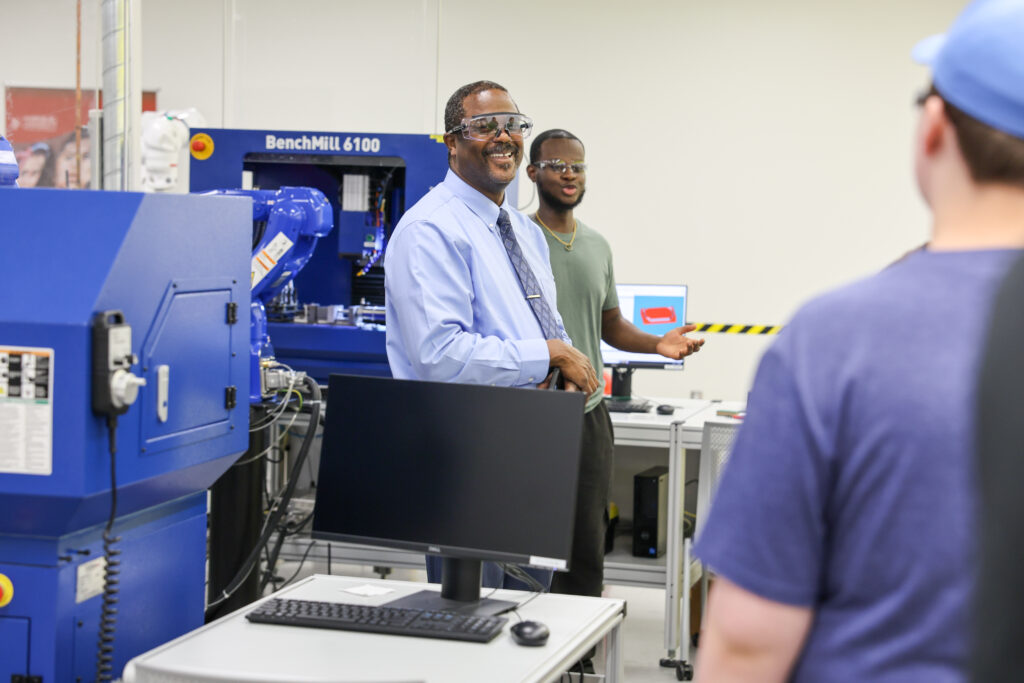
To connect the simulation to the working world, Williams told the students to open the biggest factory they could find. They chose the automated warehouse — and when he asked what company might operate one, the answer was immediate and unanimous: Amazon.
“I asked, could they envision Amazon having more than one rack? They said yes — 18 or 20 or 50 racks. And is Amazon the only company with a big warehouse like that? They quickly recognized, no. If they could program that automated warehouse, they would become interesting to those companies.”
Then came the question that made the pathway concrete: what does a person who designs these systems get paid? The students guessed in the range of $90,000 to $120,000 a year. “All of them appreciated that type of salary,” Williams said.
The real-world connection registered with the visitors, too. “They were intrigued to learn that the same program used in coursework at HU was the same for industry professionals,” Walsh said.
Williams then pointed out that each of the simulator’s scenes represents a different sector of the economy. “What would Coca-Cola have in that tank? Soda. What would Exxon have in it? Gasoline. That’s a sector.” From manufacturing to logistics to agriculture, the students saw that every sector holds good jobs — and that exploring them early matters. “The earlier you find what you like, the happier and more satisfied you’ll be with the work you’re doing. Even realizing ‘I don’t want to deal with gasoline at a refinery’ — if they realize that early, that’s valuable.”
The message landed. Miss N.P., an aspiring automotive engineer who is also curious about healthcare applications, said the experience “will definitely help me with my engineering.”
‘Did Anybody Get Hurt? Did We Waste Any Money?’
Not every student’s simulated factory worked by the end of the session. And that, Williams said, was exactly the point.
“I asked: did anybody get hurt? No. Did we waste any money? No. Did we explore different design ideas? Yes. And if you could solve why it didn’t work, could you use that to build the real factory? Yes.”
Because each student worked at their own station, collaboration emerged naturally. When one student couldn’t get her factory running, a classmate leaned over: “Try this.” She rotated her view, found the actuator, failed on her first attempt, and then — supported by her classmate — succeeded.
“Frustration is education, but success breeds success,” Williams said. “They had both happen in the same experience.”
That spirit wasn’t lost on the students. “I really liked all the people here,” said Jonathan R. “Everyone was very nice and friendly and fun. I think the people were my favorite part, because everyone made it a very fun experience.”
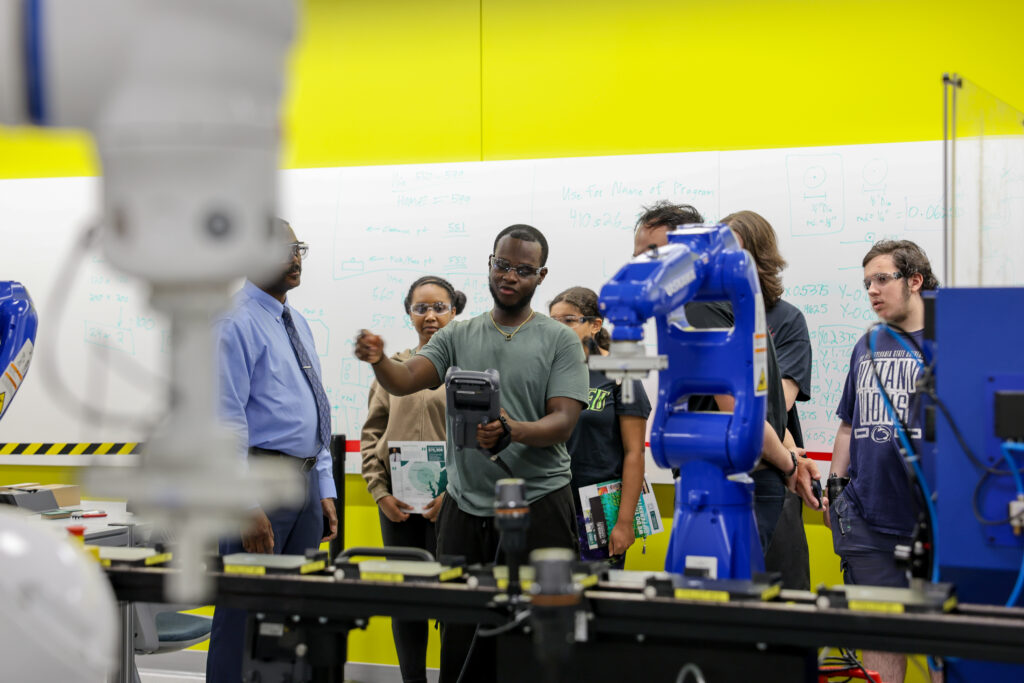
The session closed with a walk from the digital world into the physical one: from the simulated factory to HU’s physical smart factory, and the concept that ties them together: the digital twin. “All of them were able to connect to that,” Williams said.
Laser Tag and Lab Safety
The simulated factory wasn’t the group’s only step into a virtual world. In HU’s newly launched Makerspace, students jumped into a virtual laser tag game — “eager to try and let out their competitive spirit,” Walsh said.
The technology behind the game does serious work, too. “We learned similar technology was used to help create HU’s virtual tour, and that HU students are designing virtual training modules for lab safety and machine learning in various workspaces,” Walsh said.
Planting STEM Seeds
For Williams, camps like this one plant seeds that pay off years later. He connects his strongest students with engineers from companies including Mitsubishi, Phoenix Contact, and Hitachi. One recent example: HU student Logan Trimmer ’26 spent last summer troubleshooting components alongside senior engineers at Phoenix Contact.
“The growth for Logan — you could literally see it,” Williams said. “It was one of the best exchanges.”
The camps also sharpen his own teaching. His biggest takeaway from this group: don’t overload them. “They can only absorb so much. I try to bring it back to three things to remember. If you overload them, it’s like taking a fire hose to a little tomato plant.”
Judging by the students, the watering level was just right. “This is my fourth time coming here,” Yaasiel said, “and every time I come, it puts another creative part in my brain — I start thinking about other things to be creative about.”
Walsh, who has brought PA Cyber students to HU on multiple occasions, has watched those seeds take root. “HU has been a fantastic partner for providing secondary schools opportunities for hands-on STEM experiences,” he said. “The energy and excitement for learning at HU is contagious. Each time I bring students, HU helps break down the walls — the idea that STEM is for a select few — and reminds us that we all have an inner scientist.”
If this visit had a theme of its own, Walsh said, it was “have the willingness to try.”
“HU has set a new benchmark for STEM engagement and education,” he added, “and they prove time and time again that small institutions can have a big impact.”
# # #
ABOUT HARRISBURG UNIVERSITY
Harrisburg University of Science and Technology (HU) is an independent, nonprofit university offering degrees in advanced manufacturing, engineering, robotics, nursing, cybersecurity, and other critical fields. Accredited by the Middle States Commission on Higher Education, HU serves a diverse student body through bachelor’s, master’s, and doctoral programs that link learning and research with practical applications. For information about HU’s affordable STEM degrees and professional development programs, call 717.901.5146 or email Connect@HarrisburgU.edu. Stay in the know by following Harrisburg University on LinkedIn, Instagram, and Facebook.
MEDIA CONTACT
Do you have questions about this story? Interested in lining up an interview? Please contact Dan Wilhelm, Director of Communications for Harrisburg University, at DWilhelm@HarrisburgU.edu or 717.901.5100×1724.
# # #