
HARRISBURG, PA — How do children learn to “switch gears” between simple rules and the meanings of concepts? A new collaborative international study by cognitive scientists from the University of Padua (UNIPD) and Harrisburg University of Science and Technology (HU), offers the first in-depth look at how two kinds of flexibility – executive and semantic – develop in early childhood, and how they relate to each other as the brain grows. The preprint, Developmental Trajectories of Executive and Semantic Flexibility Using Task-Switching, presents findings from a large sample of children ages 4 to 10 and highlights a complex, intertwined developmental process.
The research – part of the Marie Skłodowska-Curie Actions (MSCA) Global Fellowship program’s CTRL-ALT-DEV project – is led by Maria Montefinese, PhD, a Visiting Research Scholar at Harrisburg University and Assistant Professor at the University of Padua. The study, co-authored by Erin M. Buchanan, PhD, Professor of Cognitive Analytics at Harrisburg University among other colleagues of the University of Padua, challenges existing notions about cognitive control by directly comparing two facets of flexibility that, until now, have largely been studied separately.
Charting Two Forms of Flexibility
Cognitive control enables humans to adapt their behavior: balancing stability (maintaining a rule or goal) with flexibility (changing when needed). Traditionally, researchers have examined executive flexibility – the ability to shift between tasks or rules – using task-switching tests that involve simple perceptual judgments. These tests help explain how children handle shifting demands, like alternating between homework and distractions.
In contrast, semantic flexibility – the ability to shift between different meanings of concepts – has remained largely uncharted, especially in children. Semantic flexibility is vital in real-world thinking: it allows a child to realize that a “jam” may refer to a fruit preserve or a traffic blockage, depending on context.
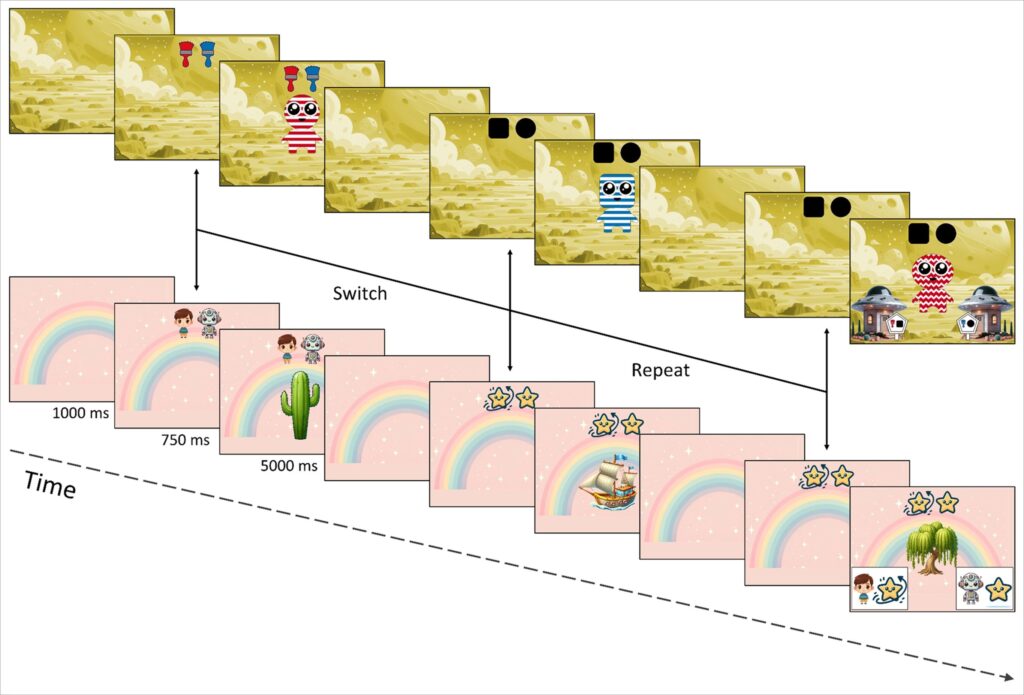
To study both forms together, researchers administered parallel task-switching paradigms to 618 Italian children, ages 3 years 10 months to 10 years 10 months. Participants completed:
- a gamified executive task (sorting cartoon aliens by color or shape), and
- a novel semantic task requiring semantic judgments about familiar objects (e.g., whether something is living or capable of movement).
Both tasks were presented using engaging narratives and visual cues to support sustained participation.
…
Strong Links and Key Differences
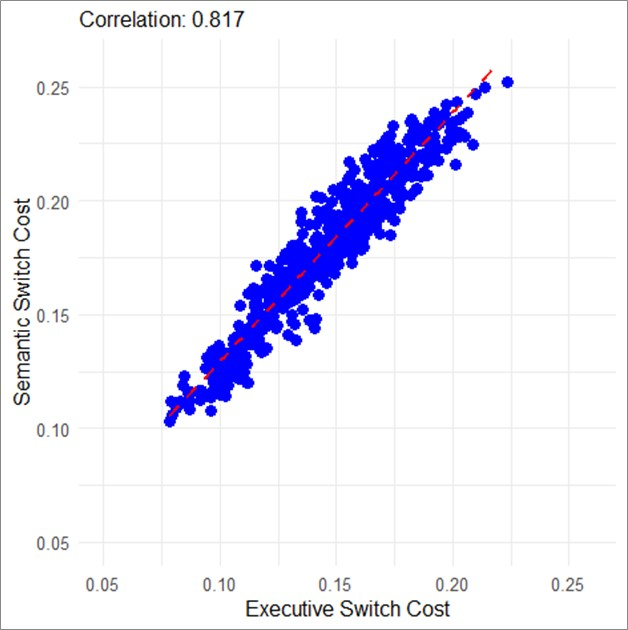
Analyses showed a strong correlation between executive and semantic switch costs (the increased time and effort children take when switching between different rules or meanings), which suggested shared cognitive mechanisms. The results echo patterns seen in adult studies but, crucially, now establish that these shared mechanisms are already present throughout childhood.
At the same time, age-related differences revealed distinct aspects of how these types of flexibility mature. In particular:
- Executive switch costs were larger than semantic ones, indicating that shifting between simple perceptual rules demands more control early in development.
- Semantic flexibility showed steeper age-related improvement, suggesting that as children’s conceptual knowledge becomes organized and efficient, they become better at applying meaning-based flexibility.
“We see that children’s developing conceptual systems shape how flexibly they can think,” Dr. Montefinese said. “Rather than acting independently, these systems – domain-general and domain-specific – grow together while maintaining distinct developmental characteristics.”
…
Why This Matters
Understanding how flexibility evolves is vital for developmental science, education, and clinical practice. Executive flexibility influences academic readiness and success, while semantic flexibility supports language development, problem solving, and real-world thinking.
By integrating child-friendly task designs with rigorous statistical modeling, including linear mixed-effects models and semantic distance measures, the research team uncovered how flexibility unfolds across both rule-based and meaning-based domains.
“This project’s design allowed us to align real-world semantic complexity with classic control measures,” said Dr. Buchanan. “It gives us a more complete picture of how flexible cognition emerges and highlights how knowledge and control systems work together during development.”
Looking Forward
These findings not only bridge gaps in theories of cognitive development but also pave the way for future studies that may incorporate brain activity measures, such as high-density electroencephalography (EEG), to uncover neural underpinnings of flexibility. They also open new possibilities for early educational strategies and potential interventions that bolster flexible thinking in both typical and atypical developmental pathways.
The full preprint is available now on Research Square.
# # #
ABOUT HARRISBURG UNIVERSITY
Harrisburg University of Science and Technology (HU) is an independent, nonprofit university offering degrees in advanced manufacturing, engineering, robotics, nursing, cybersecurity, and other critical fields. Accredited by the Middle States Commission on Higher Education, HU serves a diverse student body through bachelor’s, master’s, and doctoral programs that link learning and research with practical applications. For information about HU’s affordable STEM degrees and professional development programs, call 717.901.5146 or email Connect@HarrisburgU.edu. Stay in the know by following Harrisburg University on LinkedIn, Instagram, and Facebook.
MEDIA CONTACT
Do you have questions about this story? Interested in lining up an interview? Please contact Dan Wilhelm, Communications Manager for Harrisburg University, at DWilhelm@HarrisburgU.edu or 717.901.5100×1724.
# # #