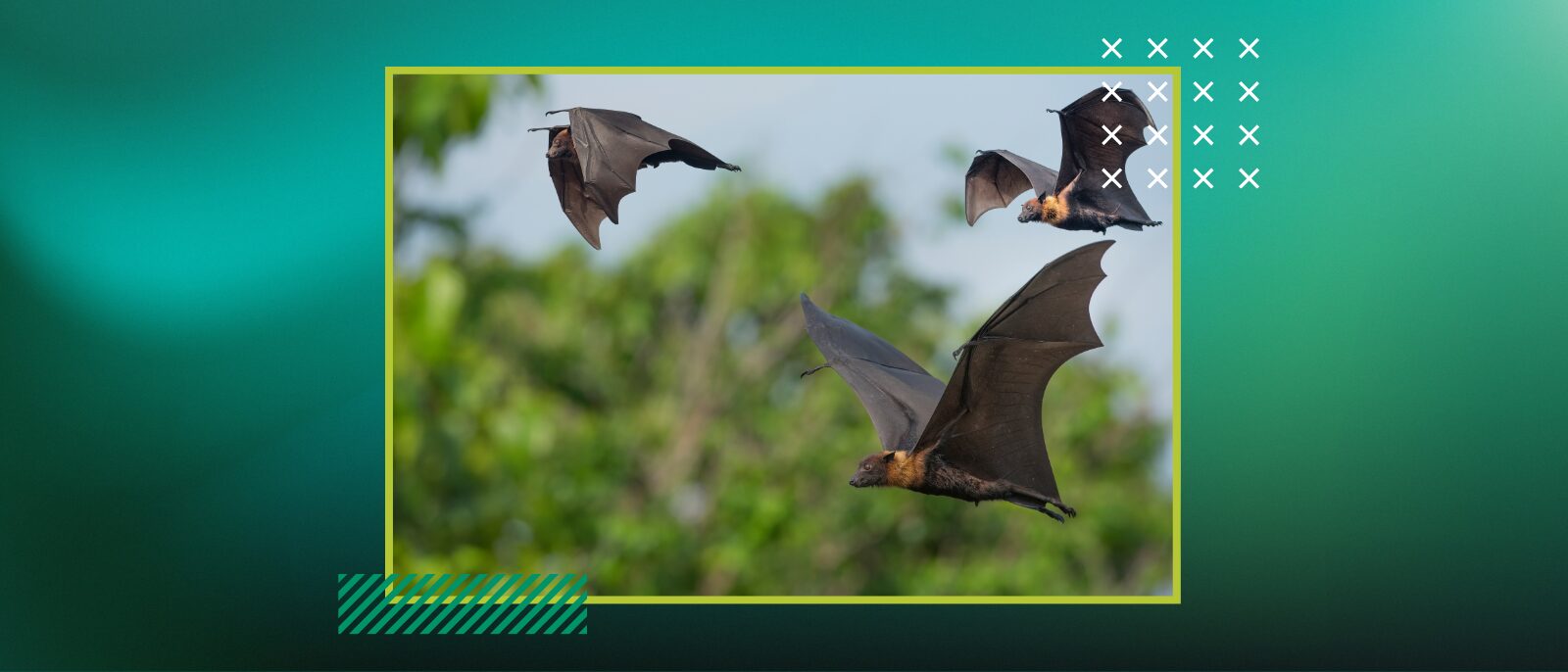
HARRISBURG, PA — Harrisburg University of Science and Technology (HU) Associate Professor of Data Science, Alan Hitch, is among the co-authors of a new peer-reviewed study, published in Scientific Reports, that documents a practical path for reducing bat deaths at wind farms in Southeast Asia: one of the world’s fastest-growing wind energy markets.
The study, “Establishing baselines for echolocating bat activity at wind farms in mainland Southeast Asia,” is the first publicly available research documenting bat activity and the environmental factors influencing it at a wind farm in the region.
Wind energy has expanded rapidly across Southeast Asia, with Vietnam alone planning to quadruple its current wind capacity by 2030. But wind turbines pose a real danger to bats, and Southeast Asia is home to roughly one-quarter of the world’s bat species, including many that are threatened. Because bats reproduce slowly, even modest increases in turbine-related deaths can put local populations at risk of disappearing entirely.
To better understand the risk, Professor Hitch and his co-authors installed acoustic detectors at four wind turbines at the ACEN wind farm in southern Vietnam and recorded bat activity continuously for one full year. Over that period, the detectors registered more than 329,000 bat detections representing 11 species.
The team’s central finding was both simple and actionable: bats fly almost exclusively when wind speeds are low. Roughly three-quarters of all bat detections occurred at wind speeds of 5 meters per second or below; once wind speeds exceeded about 7 meters per second, bat activity dropped to nearly nothing.
That pattern points to a conservation strategy known as “curtailment,” which involves temporarily slowing or stopping turbine blades during low-wind periods when bats are most active. Done carefully, the approach can prevent the majority of bat fatalities while preserving most of a wind farm’s power production. The study argues that this kind of targeted curtailment should become standard practice as the region’s wind sector continues to grow.
Hitch’s expertise in Bayesian statistical modeling — a method especially well-suited to drawing reliable conclusions from complex ecological data — helped shape the study’s analytical framework.
“Working on this project has been a real privilege,” Hitch said. “Bats are some of the most ecologically important and most misunderstood animals on the planet, and Southeast Asia is one of the regions where the stakes are highest for getting wildlife and renewable energy policy right. To be part of a team applying modern statistical tools to fill a real gap in publicly available data, and to have those findings published in Scientific Reports, is a genuine point of pride.”
The full study is available now via open access.
# # #
ABOUT HARRISBURG UNIVERSITY
Harrisburg University of Science & Technology (HU) is an independent, nonprofit university offering degrees in advanced manufacturing, engineering, robotics, nursing, cybersecurity, and other critical fields. Accredited by the Middle States Commission on Higher Education, HU serves a diverse student body through bachelor’s, master’s, and doctoral programs that link learning and research with practical applications. For information about HU’s affordable STEM degrees and professional development programs, call 717.901.5146 or email Connect@HarrisburgU.edu. Stay in the know by following Harrisburg University on LinkedIn, Instagram, and Facebook.
MEDIA CONTACT
Do you have questions about this story? Interested in lining up an interview? Please contact Dan Wilhelm, Director of Communications for Harrisburg University, at DWilhelm@HarrisburgU.edu or 717.901.5100×1724.
# # #