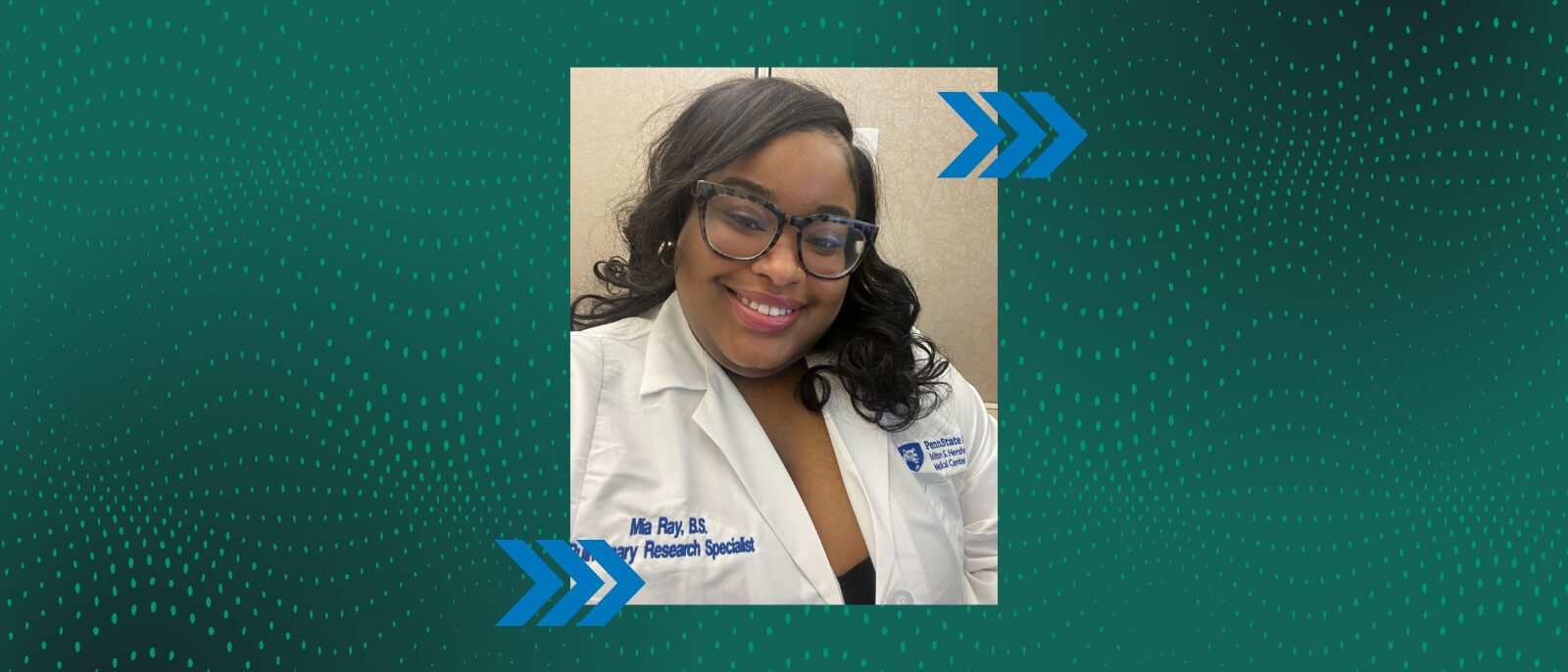
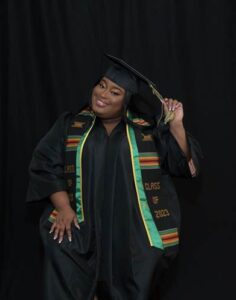
HARRISBURG, PA — Mia Ray’s interest in science started with curiosity about how the world works and quickly grew into a deeper fascination with biology and environmental systems. A 2023 graduate of Harrisburg University of Science and Technology (HU), she earned her degree in Integrative Sciences with a concentration in Biology, where she began shaping the foundation for her research interests.
Today, Mia works as a Human Research Technologist at the Penn State College of Medicine, where she supports research focused on how environmental exposures impact lung health. Her work also involves community-engaged research, including partnering with local populations to better understand exposure risks and support environmental justice efforts.
We spoke with Mia about her journey through HU, what drew her to research, and the path she’s taken since graduating.
Can you share what you studied at Harrisburg University and what initially sparked your interest in your field?
I studied Integrative Sciences with a concentration in Biology at Harrisburg University of Science and Technology. I’ve always known science was my thing. I explored everything from forensics to medical sciences, but that curiosity really started in middle school.
I did a project on how fruit enzymes can break down gelatin, and I remember being fascinated that something so simple, using everyday items, could explain something so complex. That moment made me fall in love with science not just as a subject, but as a way to tell stories about how the world works.
My interest in research didn’t click until my senior year in an ecology course with Dr. Christine Proctor. We studied the relationship between impervious surfaces and CO₂ emissions and found results that actually contradicted existing literature. Instead of being discouraged, I was drawn in. I wanted to understand why.
That experience showed me that research isn’t just about answers, it’s about asking questions no one has figured out yet. That’s what pulled me in.
You’re currently a Human Research Technologist at Penn State College of Medicine. Can you tell us about your role and the type of research you’re involved in?
In my role as a Human Research Technologist at Penn State College of Medicine, I work with Rebecca Bascom on projects that explore how environmental exposures impact lung health.
Our work looks at things like cleaning product exposures, radon (which is the second leading cause of lung cancer), wildfire smoke, and air pollution. These exposures can contribute to a range of health outcomes, from irritation to chronic diseases like interstitial lung disease and pulmonary fibrosis.
What makes our work unique is that it’s not just lab-based. We partner directly with communities. For example, in places like Steelton, Pennsylvania, we use community air monitoring and engage residents, especially youth, in understanding their own exposure data. That’s important because many of these communities face both environmental and socioeconomic disparities.
I also serve as the Program Coordinator for the Penn State chapter of the Global Council for Science and the Environment (GCSE) EnvironMentors program. Through this program, we support middle and high school students from underrepresented backgrounds in conducting their own research projects from start to finish, alongside undergraduate and faculty mentors. It’s about showing students they’re not just future scientists; they’re scientists right now.
You also serve as an Environmental Justice Advisory Board Member for the Pennsylvania Department of Environmental Protection. What does that work involve, and why is it important right now?
As a member of the Environmental Justice Advisory Board for the Pennsylvania Department of Environmental Protection, my role is centered on making sure community voices are heard in state-level decision-making.
I work closely with communities, especially Black and brown communities, to understand the environmental challenges they’re facing, whether that’s illegal dumping, traffic-related air pollution, or proximity to industrial sites. These are issues that people often have little control over, but that deeply impact their health and quality of life.
This role is important right now because environmental justice isn’t just about data; it’s about representation. It’s about making sure that the lived experiences of communities are not only acknowledged but documented and considered in policy decisions. Even when change isn’t immediate, making sure those voices are on record matters.
Congratulations on being selected as 1 of 25 fellows out of 1,700 applicants for the Center for Engagement, Environmental Justice & Health (CEEJH) Climate Justice Fellowship! What does this fellowship mean to you, and what are you most excited to explore through it?
Being selected for the Center for Engagement, Environmental Justice & Health Climate Justice Fellowship was a full-circle moment for me.
After graduating, I wasn’t entirely sure what direction I wanted to take. I knew I loved science, but I was still figuring out where I fit. When I started my current role, I had a strong health background but limited experience with environmental science, so I had to learn a lot on the job.
This fellowship gives me the opportunity to deepen that knowledge in a more structured way by exploring climate change, environmental justice, and the historical and social factors that shape exposure risks in communities of color.
What excites me most is the ability to better connect my work in research with community engagement. I want to continue building that bridge between data, science, and lived experience, and this fellowship is helping me do that in a more intentional way.
Looking back, how did your experience at Harrisburg University help prepare you for the work you’re doing today? Are there specific courses, professors, or experiences that stand out?
Harrisburg University prepared me for this work by teaching me how to think like a researcher. Courses like Project I and Project II were especially impactful. Project I focused on understanding the existing landscape of a topic, while Project II challenged us to ask new questions and contribute original research. That process mirrors exactly what I do now.
Another defining experience was taking molecular biology and ecology at the same time. It pushed me to connect what’s happening at the molecular level in the body with what we’re exposed to in our environment, air, water, and beyond. That connection is at the core of the work I do today.
What has been the most defining moment in your professional journey so far?
One of the most defining aspects of my professional journey so far has been the opportunity to grow in spaces that directly impact people’s lives.
At Penn State, I’ve developed technical skills like coding in SAS and R, but just as importantly, I’ve developed skills in mentorship and community engagement. I’ve worked alongside doctors, researchers, students, and community members on projects that are rooted in real-world impact.
Being able to mentor students through their own research journeys and help them find their voice has been especially meaningful. At the same time, working with communities has taught me that communication is just as important as the science itself. If people don’t understand the research, we can’t call it accessible.
What advice would you give to current HU students who are interested in research, public health, sustainability, or policy-driven work?
My advice to current HU students is simple: don’t let fear talk you out of opportunities. If something feels intimidating, that usually means it’s pushing you to grow. Don’t count yourself out because something feels “out of your league.” You don’t have to know everything; you just have to be willing to learn. Trust that you’re where you’re supposed to be and take the leap anyway.
What impact do you hope your work will have in the next five years?
In the next five years, I hope my work helps reshape how we communicate health and environmental information, especially for marginalized communities. Access isn’t just about making resources available; it’s about making sure people actually understand and can use that information. That’s why community engagement is so important in our work.
By working with communities, not just in them, we can create research that is not only informative but truly impactful. My goal is to help build a model where science is accessible, culturally relevant, and driven by the people it’s meant to serve.
# # #
ABOUT HARRISBURG UNIVERSITY
Harrisburg University of Science & Technology (HU) is an independent, nonprofit university offering degrees in advanced manufacturing, engineering, robotics, nursing, cybersecurity, and other critical fields. Accredited by the Middle States Commission on Higher Education, HU serves a diverse student body through bachelor’s, master’s, and doctoral programs that link learning and research with practical applications. For information about HU’s affordable STEM degrees and professional development programs, call 717.901.5146 or email Connect@HarrisburgU.edu. Stay in the know by following Harrisburg University on LinkedIn, Instagram, and Facebook.
MEDIA CONTACT
Do you have questions about this story? Interested in lining up an interview? Please contact Dan Wilhelm, Communications Manager for Harrisburg University of Science and Technology, at DWilhelm@HarrisburgU.edu or 717.901.5100×1724.
# # #