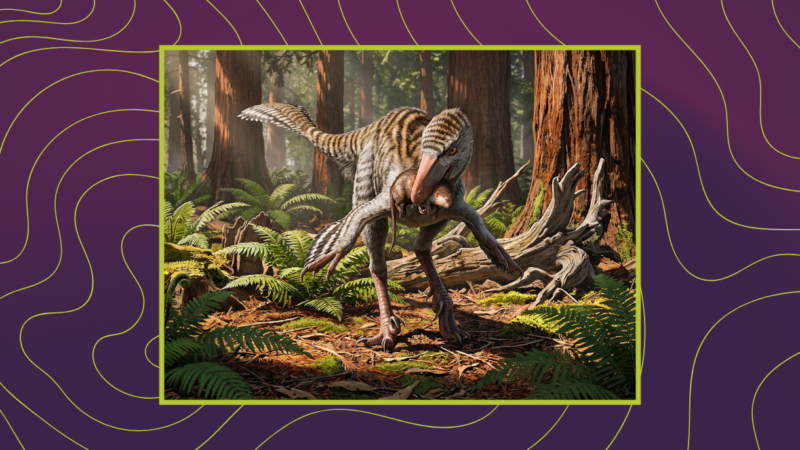
HARRISBURG, PA — Paleontologists from Harrisburg University of Science and Technology (HU) and the New Mexico Museum of Natural History and Science — Drs. Steven Jasinski and Robert Sullivan — have recently named and described Dinevenator, a new genus of theropod dinosaur closely related to Troodon.
Jasinski, a professor of environmental science at HU and curator of paleontology at the New Mexico Museum of Natural History and Science, and Sullivan, a research associate at the museum, based the new genus on a fossil first described in 2006. Dinevenator is a troodontid, a group of theropods related to Troodon, Stenonychosaurus, Albertavenator, and Xenovenator. These theropods are well known for having unusually large brains relative to other dinosaurs.
Dinevenator robustus, its full species name, roamed a subtropical floodplain in what is now New Mexico 73 million years ago. It lived alongside the famous crested duck-billed dinosaur Parasaurolophus tubicen, armored ankylosaurs such as Nodocephalosaurus and Ziapelta, horned ceratopsids, dome-headed pachycephalosaurs such as Sphaerotholus, swift dromaeosaurids such as Saurornitholestes sullivani, and large tyrannosaurs.
In the summer of 2005, while collecting Cretaceous fossils in the San Juan Basin of northwestern New Mexico, Sullivan came across part of the skull of a small theropod dinosaur in the De-na-zin Member of the Kirtland Formation. First thought to be a dromaeosaur, a relative of Velociraptor, it was later identified as a troodontid, a closely related group of dinosaurs.
More recent work on several other Late Cretaceous troodontids, including Albertavenator from Alberta and Xenovenator from northern Mexico, prompted a new study of the De-na-zin specimen.
Although Dinevenator robustus is known only from a frontal — a single bone on the top of the skull — that bone is distinctive. It is thicker than the same bone in many similar dinosaurs and carries several other features that set the animal apart.
“While these dinosaurs are known for having relatively large brains compared to many other dinosaurs, we are only now learning more about and understanding their biodiversity,” said Jasinski.
Although little fossil material is known of Dinevenator, scientists can use data from closely related species to reconstruct the animal. They estimate this bipedal theropod measured 2.5 to 3 meters (about 8 to 10 feet) in body length and weighed 70 to 140 kilograms (about 150 to 300 pounds), making it one of the larger troodontids known.
Jasinski and Sullivan also ran an analysis to determine how Dinevenator robustus is related to other troodontids. They found Dinevenator to be closely related to Albertavenator and Xenovenator, and part of a group of troodontids with more robust skulls than relatives such as Troodon, Stenonychosaurus, and Latenivenatrix.
“Not only is Dinevenator part of a robust-skulled group of troodontids, but they are also younger than the more slender-built forms,” Jasinski said. “This really helps us get a clearer picture of troodontid diversity in the Late Cretaceous in North America and adds to our knowledge of dinosaurs that once roamed New Mexico.”
Jasinski has contributed to research naming several new dinosaur, mammal, and turtle species in recent years, including the ceratopsids Menefeeceratops sealeyi, Sierraceratops turneri, and Bisticeratops froeseorum; the tyrannosaurid Tyrannosaurus mcraeensis; the duck-billed dinosaur Ahshislesaurus wimani; the fossil turtles Hutchemys walkerorum and Chrysemys corniculata; and the carnivorous mammals Circamustela bhapralensis and Metapterodon anari.
The paper naming Dinevenator, published in the scientific journal Fossil Studies, is available at https://www.mdpi.com/2813-6284/4/3/21.
ABOUT HARRISBURG UNIVERSITY
Harrisburg University of Science and Technology (HU) is an independent, nonprofit university offering degrees in advanced manufacturing, analytics, biotechnology, cybersecurity, nursing, and other critical fields. Accredited by the Middle States Commission on Higher Education, HU serves a diverse student body through bachelor’s, master’s, and doctoral programs that link research with practical applications. For information about HU’s affordable STEM degrees and professional development programs, call 717.901.5146 or email Connect@HarrisburgU.edu. Stay in the know by following Harrisburg University on Facebook, Instagram, LinkedIn, X, and YouTube.
MEDIA CONTACT
Do you have questions about this story? Interested in lining up an interview? Please contact Dan Wilhelm, Director of Communications for Harrisburg University, at DWilhelm@HarrisburgU.edu or 717.901.5100×1724.
# # #