When a defense contract gets announced, the number in the headline is always a dollar figure. Ten billion. Eighty-four million. Money is the easiest part of the story to tell.
But a contract is not a product. Somewhere downstream of every one of those numbers is a building with machines in it, and somewhere inside that building is a person who knows how to run them. Over the past year, Pennsylvania has accumulated an extraordinary number of those contracts. The question that gets far less coverage is who fills the buildings.
Here’s a look at what the Commonwealth has committed to, what “advanced manufacturing” actually means on a factory floor, and why the hardest part of the buildout has nothing to do with capital.
The Scale of What Was Announced
In July, U.S. Sen. Dave McCormick’s Pennsylvania Defense and Innovation Summit at the U.S. Army War College in Carlisle produced more than 30 separate announcements totaling roughly $10 billion in new investment and nearly 5,000 projected jobs. Here’s just a sample:
- Rhoads Industries and General Dynamics Electric Boat signed a 10-year, $2.5 billion agreement for submarine work at the Philadelphia Navy Yard, supporting about 1,350 jobs through 2035.
- Hanwha Philadelphia Shipyard received National Security Multi-Mission Vessel orders valued at $1.5 billion in program costs, supporting more than 2,000 jobs.
- Kratos Defense announced a 167,000-square-foot advanced manufacturing facility in York — its third in Pennsylvania — backed by more than $7 million in new production equipment.
- Attalon is opening an 80,000-square-foot Philadelphia headquarters in 2027 that will more than quadruple U.S. precision coatings production for guided munitions.
- Mack Defense in Allentown took an additional Army order for 115 heavy dump trucks, bringing its 2026 total to 208 under a five-year contract worth up to $221.8 million.
Spread across Philadelphia, York, Allentown, Erie, and Pittsburgh, this is not a single project; it’s a supply chain being reassembled in place.
What Happened at Tobyhanna
The most instructive announcement of the year, though, wasn’t at the summit. In June, the Army opened an advanced manufacturing line at Tobyhanna Army Depot in Monroe County to produce brushless motors for small drones: 480,000 units a year, feeding the Pentagon’s Drone Dominance program.
Yes; that’s a strange sentence to write about a depot built to repair radios.
Tobyhanna has been fixing electronics since the Second World War. Its new assignment is producing components at consumer-electronics volume, to defense tolerances, on a line that didn’t exist eighteen months ago. The Army chose that site partly because the depot already had deep expertise in electronics work. The capability was latent; the mission changed around it.
Pennsylvania is not building an industrial base from nothing. It is converting one — and conversion is a people problem before it is a capital problem.
Okay, but What Exactly Is “Advanced” Manufacturing?
The word “advanced” gets attached to manufacturing so routinely that it has nearly stopped meaning anything. On an actual floor, it means something specific and demanding. It means:
- Robotic cells that have to be programmed, tended, and re-tooled when the part changes;
- Additive and subtractive processes running alongside each other, with someone deciding which is appropriate for a given component;
- Metrology, statistical process control, and quality systems rigorous enough to satisfy a defense customer who will audit them;
- Networked equipment generating data that only helps if somebody knows what to do with it.
None of that is a button-pushing job; none of it disappears when the next machine arrives. The equipment keeps getting more capable, which raises rather than lowers the skill floor for the person standing next to it. This has, inevitably, led to skill gaps that manufacturers are struggling to fill.
The gap is not hypothetical. Carnegie Mellon and Carnegie Foundry announced a national initiative in July to build an Autonomous Systems Manufacturing Platform that American manufacturers can deploy in their own factories to produce drones at national-security scale. The platform is the (relatively) easy half. The people who deploy it in a plant in York or Erie are the hard half, and they have to come from somewhere.
“I work with the Army, the Navy, and the Marine Corps, and with manufacturers across the Commonwealth,” said LJ Holmes, Executive Director of STORMWERX, Harrisburg University’s Center for Advanced Manufacturing and Materials. “Every one of them can tell me what they’re about to build. Fewer can tell me who’s going to build it.”
Where Harrisburg University Fits
This is a conversation J-DAMMIT 2026 was built to have. The summit convenes at the UPMC Health Sciences Tower August 25 through 27, bringing together defense, advanced manufacturing, and academic partners on exactly this question: how the Commonwealth turns announcements into production capacity.
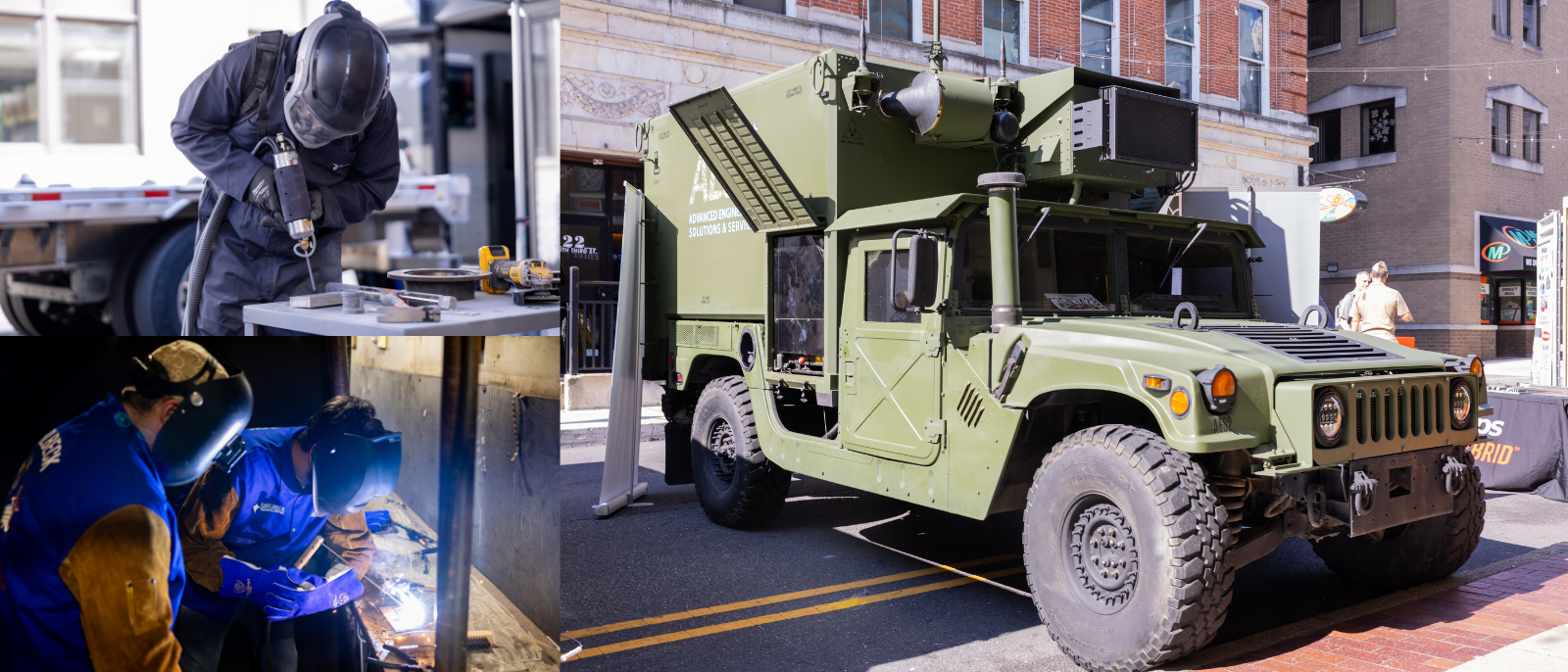
HU’s Advanced Manufacturing and Robotics program exists for the same reason. Students work with the robotics, automation, and fabrication systems that these facilities are installing right now. Not as a survey of the field, but as hands-on preparation for the floor.
America’s Industrial Base Runs on People
Pennsylvania has been at this since 1775, and the Commonwealth has been through this cycle before. FDR’s “Arsenal of Democracy” wasn’t a set of contracts; it was a generation of people who learned to build things they had never built before, quickly, and to a standard that mattered.
The contracts announced this summer will be delivered by people who are, at this moment, deciding what to study. If you want to help advance this conversation and determine the future of defense readiness and manufacturing capacity in Pennsylvania and beyond, explore the B.S. in Advanced Manufacturing and Robotics. Want to see what these theories look like in practice? Come out to Harrisburg University for J-DAMMIT 2026. Admission is free and every optional donation directly supports Harrisburg University student scholarships.
ABOUT HARRISBURG UNIVERSITY
Harrisburg University of Science and Technology (HU) is an independent, nonprofit university offering degrees in advanced manufacturing, analytics, biotechnology, cybersecurity, nursing, and other critical fields. Accredited by the Middle States Commission on Higher Education, HU serves a diverse student body through bachelor’s, master’s, and doctoral programs that link research with practical applications. For information about HU’s affordable STEM degrees and professional development programs, call 717.901.5146 or email Connect@HarrisburgU.edu. Stay in the know by following Harrisburg University on Facebook, Instagram, LinkedIn, X.com, and YouTube.
# # #
