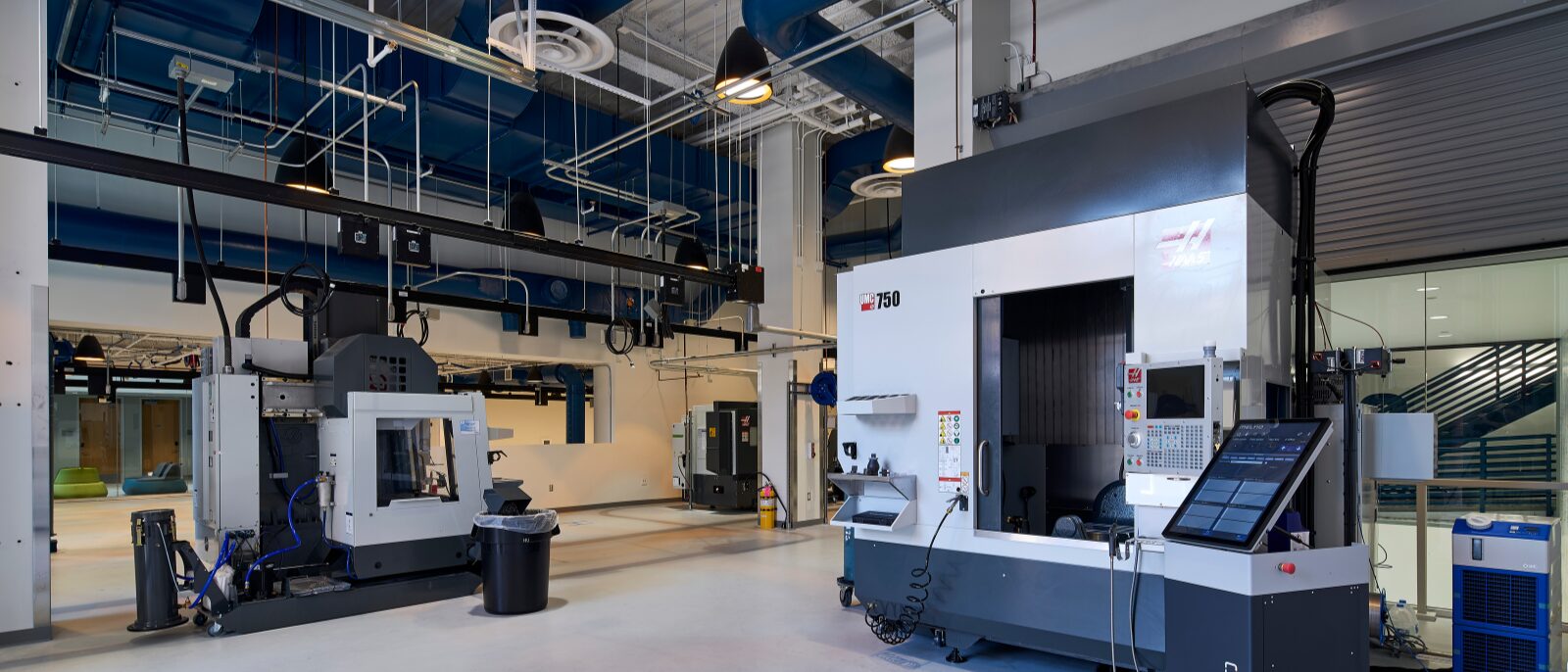
Advanced manufacturing is the use of robotics, automation, digital technologies, and engineered materials to design and produce goods with greater precision, speed, and flexibility than traditional methods allow. It merges physical processes (machining, welding, casting, molding, and 3D printing) with digital ones (computer-aided design, simulation, sensors, data analysis, and machine learning) so that the design lab and the production floor operate as one connected system.
If that sounds like engineering, it is! If it also sounds like computer science, it’s definitely that, too. Advanced manufacturing lives where those disciplines meet, and the result is some of today’s most lucrative, rewarding, and durable technical careers. When you choose advanced manufacturing, you’re choosing possible futures in in aerospace, medical devices, semiconductors, automotive, national defense, energy, and consumer products.
This guide explains what advanced manufacturing involves, what people mean when they say “Industry 4.0” and “Industry 5.0,” and what separates a serious advanced manufacturing degree from one that only looks the part.
Advanced Manufacturing vs. Traditional Manufacturing
Traditional manufacturing is not obsolete; nearly every advanced process still rests on it. What’s different today is how much information moves through the system and how much decision-making happens before a single piece of material is cut.
- Standalone machines became connected machines that report their own temperature, load, cycle time, and wear.
- Physical trial and error became simulation, where a process is tested in software (sometimes against a full digital twin of the factory) before anything is built.
- Subtractive-only production (machining) became one tool in a toolbox that also includes additive (3D printing), formative (casting and molding), and hybrid (combinations of all three).
- Single-machine operators became technologists who program, integrate, and troubleshoot across an entire production system.
It’s that last change that matters most for students. The job is no longer to run one machine well. It is to understand how a system of machines, controls, materials, and data fits together. And then to improve it.
What Is Industry 4.0?
The term “Industry 4.0” is the shorthand for the fourth industrial revolution: the moment when manufacturing became connected and data-driven. It is the fourth chapter in a long story:
- First: steam power, mechanization.
- Second: electricity, interchangeable parts, the assembly line.
- Third: computers, electronics, early automation.
- Fourth: cyber-physical systems.
In practice, Industry 4.0 is built from a recognizable set of technologies: the Industrial Internet of Things (IIoT), cloud and edge computing, big-data analytics, artificial intelligence and machine learning, advanced and collaborative robotics, additive manufacturing, augmented (AR) and virtual reality (VR), and the programmable logic controllers (PLCs) that tie equipment together on the floor. Here’s a concrete example:
A CNC machining center logs spindle load on every cut. Software watches that data across thousands of parts, recognizes the signature of a dulling tool, and flags it before a single part drifts out of tolerance. The scheduling system reorders the queue automatically. Nobody scrapped a part to learn this. That is Industry 4.0.
What Is Industry 5.0?
Industry 5.0 does not replace Industry 4.0; instead, it adds a layer on top of it. The original framework, popularized by the European Commission, describes an industrial model built on three commitments: human-centric, sustainable, and resilient.
Industry 4.0 asked what technology can do. Industry 5.0 asks what it should do and who it should serve.
- Human-centric. Technology adapts to the worker rather than the reverse. Collaborative robots (“cobots”) share a workspace with people, taking the repetitive and dangerous work while humans handle judgment, adaptation, and craft.
- Sustainable. Material and energy efficiency, remanufacturing, and circular design become engineering requirements rather than afterthoughts.
- Resilient. Production can withstand disruption. This is the thinking behind distributed and expeditionary manufacturing: the ability to produce a needed part close to where it is needed, instead of waiting on a supply chain that may be months long or cut off entirely.
Industry 5.0 is an emerging framework; you will meet engineers who refer to it constantly and engineers who have never said it aloud. The underlying priorities — human-machine collaboration, sustainability, and supply-chain resilience — are shaping the field regardless of what anyone calls them.
What Is Advanced Manufacturing Used For?
Advanced manufacturing is not an industry; it is a capability that industries depend on, which is a large part of why the career paths are so varied:
- Aerospace and space systems
- Automotive and electric vehicles
- Electronics, flexible circuits, and semiconductors
- Healthcare and medical devices
- National defense and the defense industrial base
- Food, beverage, and packaging
- Textiles and consumer products
The roles behind those sectors carry titles like manufacturing engineer, robotics and automation technician, additive manufacturing specialist, controls engineer, quality engineer, process improvement engineer, and production systems designer.
What to Look for in an Advanced Manufacturing Degree
Advanced manufacturing is a hands-on discipline, and programs vary enormously in how much hands-on work they actually deliver. If you are comparing schools, these are the questions worth asking on a campus visit.
1. Machine time, not just seat time
How many hours will I spend operating industrial equipment, and in which year does that start? A program that keeps first- and second-year students in lecture halls while the equipment sits idle is teaching you about manufacturing. That is not the same as teaching you manufacturing.
2. Industry-standard equipment
There is a real difference between a desktop 3D printer and an industrial additive system, and between a tabletop robotic arm and a production-grade six-axis robot. Ask what brands and models the lab runs. Then, check whether employers in the field run the same ones. Graduating already fluent on industry-standard equipment is a massive hiring advantage.
3. A real production environment
Individual machines teach individual skills. A full smart factory — machines integrated into a working line with material handling, controls, and data flowing between stations — teaches systems thinking, which is something that employers are short on right now.
4. Breadth across processes and materials
A strong curriculum covers subtractive and additive processes, metals and nonmetals, composites and polymers, materials testing, and finishing. Narrow programs produce narrow candidates.
5. Controls, software, and simulation
This is the line between operating a machine and engineering a process. Look for PLC programming, CAD/CAM, robotics programming, manufacturing simulation, and systems integration in the required course list.
6. Industry, embedded
Does the university have partnerships that deliver experience and value to the student? Do partners bring real problems to campus? Do they fund student research? Do they hire from the program year over year?
7. Evidence of outcomes
Look for portfolios, competition teams, capstone projects with external clients, and internship placement records. A portfolio of work you built is more persuasive in an interview than a transcript.
Advanced Manufacturing at Harrisburg University
Harrisburg University’s Bachelor of Science in Advanced Manufacturing and Robotics was built around exactly those criteria. It is the only dedicated four-year advanced manufacturing degree of its kind in the United States, and the program is designed so that students work in a production environment from early in the curriculum rather than waiting until an internship or a first job to touch the equipment. What that looks like in practice:
- A full-scale smart factory. Students work in an integrated CIM/FMS environment with industrial robotic platforms from Universal Robots, FANUC, and Yaskawa — the same names running production lines across the region and the country.
- A one-of-a-kind additive lab. The program operates more than 10 industrial-scale 3D printers, giving students range across additive technologies rather than experience with a single machine.
- Breadth by design. Coursework spans robotics and automation, additive and subtractive manufacturing, metallic and nonmetallic materials, composites, polymer processing, materials testing, electronics and PLC programming, CAD/CAM, simulation, and augmented and virtual reality.
- Real work with real partners. Students collaborate with industry and government partners including NASA, Haas Automation, Phoenix Contact, Phillips Corporation, and LuxCreo, and stood out in NASA’s Lunabotics Challenge.
- A professional portfolio requirement. Every ADMA student builds one, which means graduates leave with documented, demonstrable work. Not just a transcript.
- Employment pipelines that already exist. ADMA students have secured internships and full-time roles with BAE Systems, JLG Industries, Microchip Technology, Nucor Skyline, Phoenix Contact, Ashland Technologies, Mid-Atlantic Machinery, LuxCreo, and Wolfgang Confectioners, among others.
Access is the key. Advanced manufacturing cannot be learned from a slide deck. A student who has already programmed a six-axis robot, run an industrial printer, and debugged a PLC has a different first day on the job than one who has only read about them.
See the Field in Action: J-DAMMIT
If you want to understand what advanced manufacturing looks like at full scale, plan a visit to Harrisburg University. Now in its fourth year, J-DAMMIT (Joint-Defense Advanced Manufacturing Meeting for Innovation and Transition) is hosted by Harrisburg University and STORMWERX, the University’s Center for Advanced Manufacturing and Materials. It brings hundreds of defense leaders, manufacturers, engineers, and technology providers into the manufacturing environment for three days of live demonstrations spanning additive manufacturing, CNC machining, aluminum casting, welding, and expeditionary production.
Nobody sits in an audience; this is the same principle upon which the ADMA curriculum is built, just at a larger scale. And HU students are in the middle of it, presenting research alongside industry and government experts. Proceeds from the summit fund advanced manufacturing scholarships at the University.
Frequently Asked Questions
Is advanced manufacturing a good career?
It is a field where demand is driven by durable forces: reshoring of production, defense industrial base investment, an aging skilled workforce, and the automation of processes that still need engineers to design and maintain them.
What is the difference between advanced manufacturing and mechanical engineering?
Mechanical engineering centers on designing the product (the physics, mechanics, and analysis behind how a thing works). Advanced manufacturing centers on producing it (the processes, machines, materials, controls, and systems that turn a design into a part). The disciplines overlap heavily, and the strongest engineers in either can speak the other’s language.
Do I need to be strong in math to study advanced manufacturing?
You need to be willing to build the skill, which is different from arriving with it. The math is applied and visible: tolerances, feeds and speeds, material properties, engineering economics, and data analysis. Students who struggled with abstract math often find it clicks when the numbers are attached to a machine they can hear running or a workpiece they can see and touch.
What kinds of jobs do advanced manufacturing graduates get?
Manufacturing engineer, robotics and automation technician or engineer, additive manufacturing specialist, controls engineer, CNC programmer, quality engineer, process engineer, and manufacturing systems integrator are all common destinations. The sector varies more than the skill set does. Students at HU have aspirations of working for NASA, designing theme park rides, and scaling 3D printing for the automotive industry.
Explore the Program
Harrisburg University’s BS in Advanced Manufacturing and Robotics is offered on our Harrisburg campus. To talk with someone about the curriculum, lab access, or transfer credit, request information, schedule a visit to see the smart factory in person, or start your application.
ABOUT HARRISBURG UNIVERSITY
Harrisburg University of Science and Technology (HU) is an independent, nonprofit university offering degrees in advanced manufacturing, analytics, biotechnology, cybersecurity, nursing, and other critical fields. Accredited by the Middle States Commission on Higher Education, HU serves a diverse student body through bachelor’s, master’s, and doctoral programs that link research with practical applications. For information about HU’s affordable STEM degrees and professional development programs, call 717.901.5146 or email Connect@HarrisburgU.edu. Stay in the know by following Harrisburg University on Facebook, Instagram, LinkedIn, X.com, and YouTube.
