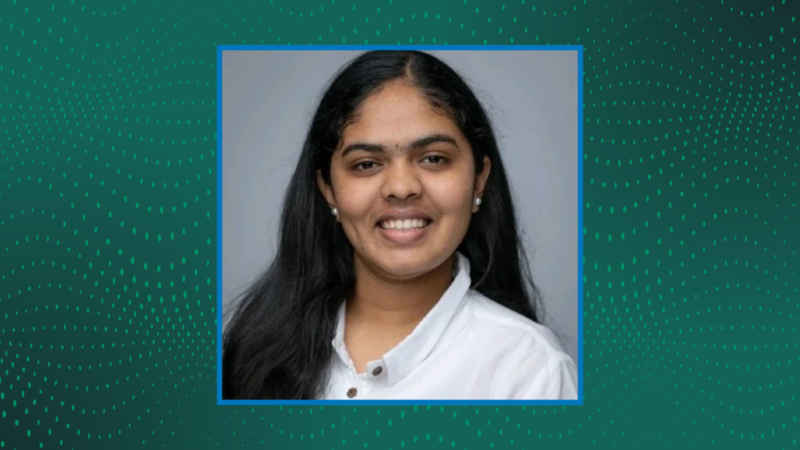
HARRISBURG, PA — Harrisburg University of Science and Technology (HU) PhD student Meetu Malhotra ’27 is making an impact in the field of artificial intelligence (AI) and machine learning through a series of recent publications and ongoing research. Meetu, who is pursuing a PhD in Data Science, has published three books over the past year: “Combating Cyberbullying With Generative AI,” “Harnessing Generative AI to Combat Cyberbullying in Industry,” and “Automating Software Defect Detection Through Machine Learning and LLMs.”
She is also currently in the final stages of publishing another book, “Decode Machine Learning,” which is expected to be released in the coming months. Drawing from more than 17 years of experience in data analytics and machine learning, including work with multiple global organizations, Meetu’s work focuses on bridging the gap between advanced AI research and real-world applications.
Below, Meetu shares more about her background, inspiration, and experience as a published author while pursuing her doctoral degree.
Can you tell us about your academic and professional background prior to coming to HU? Why did you decide to pursue graduate studies at HU?
Before joining HU, I earned a master’s degree in data science and business analytics and built over a decade of experience: contributing to projects for major global financial institutions, and with organizations like PwC and Microsoft, and strengthening my expertise in data analytics and machine learning.
I chose to pursue graduate studies at HU to further deepen my knowledge in AI. This journey has allowed me to align my extensive industry experience with cutting-edge developments in AI and data science and has also strengthened my presence as a speaker in academic and industry forums. I have served as a keynote speaker at an IEEE conference, and recently I was also invited by a university as an industry expert to deliver a talk on the cost of AI and sustainability, where the session had immediate impact, with students applying the concepts in their hackathon projects, as noted in organizer feedback.
What inspired you to publish books while completing your graduate studies?
I have published multiple books in the field of AI and machine learning to contribute to the broader community, including researchers, students, and industry professionals. Drawing on my extensive industry experience and strong academic background, I aim to translate complex concepts into practical, real-world insights that are both accessible and applicable.
For example, my upcoming book focuses on the mathematical foundations of machine learning algorithms along with their practical implementation, enabling readers to understand not only how these algorithms work but also when and where to apply them. Through these publications, I strive to bridge the gap between theory and industry practice while sharing knowledge in a meaningful way. This is my way of giving back to the community.
What gap or problem were you hoping to address with your books?
The primary gap I aimed to address through my books is the disconnect between advanced AI research and its practical, responsible application to real-world problems. In my published work on cyberbullying, I focused on a critical societal challenge – online abuse – and explored how AI, particularly generative AI and NLP (natural language processing), can be leveraged to detect and mitigate harmful behavior while also addressing ethical and privacy considerations.
The importance of this work is underscored by the growing exposure of young users to harmful online content. For instance, reports indicate that a significant percentage of tweens and teenagers encounter sexually explicit or distressing material online, which can negatively impact emotional development and normalize harmful behaviors. By presenting practical approaches and real-world use cases, my work contributes to creating safer digital environments and advancing responsible AI solutions in this space.
In another SCOPUS-indexed publication, “Automating Software Defect Detection Through Machine Learning and LLMs,” I addressed the limitations of traditional defect detection methods in handling large-scale, complex systems and using AI to overcome the same. This work highlights how the integration of machine learning and large language models can significantly improve the accuracy, scalability, and efficiency of detecting software defects. By combining predictive capabilities with advanced language understanding, it provides a modern, automated approach while also discussing challenges such as interpretability and bias.
My upcoming book is focused on filling another important gap: the lack of accessible and intuitive understanding of machine learning algorithms. It covers mathematical foundations, hands-on calculations on simplified datasets, and clear explanations in approachable language, along with practical implementation in Python. Through this book, I aim to make complex concepts understandable. Together, these efforts reflect my broader goal of bridging the gap between theory, application, and accessibility in AI and machine learning.
What was the publishing process like?
I have worked with well-known publishers such as IGI Global and Cambridge Scholars Publishing, each with its own established framework. The publishing process was a structured and rewarding experience. It typically begins with submitting a detailed book proposal outlining the scope, objectives, and target audience, which is then reviewed by the publisher’s internal editorial and review committees. In addition to the proposal, the author’s academic and professional profile is also evaluated to ensure subject-matter expertise and credibility in the field.
Once approved, the onboarding process is smooth and well-guided, with clear milestones for manuscript development, peer reviews, and multiple rounds of revisions to ensure quality and meaningful contributions. Overall, the process is collaborative, transparent, and designed to maintain high academic and professional standards.
How do your books connect to your research or long-term career goals?
My books are closely aligned with my interests and long-term career goals of advancing AI and machine learning for real-world impact. Through my work, I focus on applying AI to solve socially relevant and large-scale industry challenges. Writing these books allows me to formalize and disseminate my research in a way that is both practical and accessible to a wider audience.
How has HU supported you throughout this journey?
HU has provided me with valuable academic support through coursework, faculty interactions, and access to learning resources. The university environment has helped me in providing a growth-oriented setting that has encouraged me to push my boundaries. It helped me strengthen my conceptual understanding and explore advanced topics in AI and machine learning more deeply, which has helped me better connect academic learning with real-world applications.
What advice would you give to other graduate students who are interested in publishing?
I would advise graduate students to start with problems they are genuinely passionate about. Seeking feedback from mentors and reviewers is key to developing high-quality, publishable work.
# # #
ABOUT HARRISBURG UNIVERSITY
Harrisburg University of Science & Technology (HU) is an independent, nonprofit university offering degrees in advanced manufacturing, engineering, robotics, nursing, cybersecurity, and other critical fields. Accredited by the Middle States Commission on Higher Education, HU serves a diverse student body through bachelor’s, master’s, and doctoral programs that link learning and research with practical applications. For information about HU’s affordable STEM degrees and professional development programs, call 717.901.5146 or email Connect@HarrisburgU.edu. Stay in the know by following Harrisburg University on LinkedIn, Instagram, and Facebook.
MEDIA CONTACT
Do you have questions about this story? Interested in lining up an interview? Please contact Dan Wilhelm, Communications Manager for Harrisburg University of Science & Technology, at DWilhelm@HarrisburgU.edu or 717.901.5100×1724.
# # #