
Skip to content

Class Location/Format

The 2026 Data Analytics Certificate Program will be delivered VIRTUALLY, via Microsoft Teams – with live presenters and facilitators.  All class times listed in Eastern Time (ET), observing either EST or EDT as appropriate.

About the Course

The Harrisburg University, Data Analytics Institute, Data Analytics Certificate Program provides you with the strategic skills and techniques needed to advance your organization’s ability to perform data driven decision making.

Discuss and widen your depth of knowledge in:

  • Introduction to Business and Data Analytics
  • Descriptive Analytics: Nature of Data, Statistical Modeling and Visualization
  • Business Intelligence and Data Warehousing
  • Predictive Analytics
  • Prescriptive Analytics
  • Exploratory Data Analysis

Target Audience

The program is specifically designed for employees who are leading or will be participating in a program that involves data analytics.

Pre-Requisites/Qualifications:

To be considered for the Data Analytics Certificate Program, an employee must be nominated by their supervisor and have:

  • Experience in an organization working with data and analytics -OR-
  • Experience in managing a data analytics team or project

Curriculum/Learning Methods/Program Benefits

The certificate program is designed to:

  • Empower employees to identify the components of a successful data analytics program
  • Discriminate between some of the analytical buzzwords like ‘artificial intelligence,’ ‘machine learning,’ and ‘internet of things.’
  • Summarize the relationship among data governance, data quality and data management.
  • Learn how to create data visualizations that are appealing to a wide variety of users.

You will learn the essential elements needed to chart the path to take your data analytics program to the next level.

Led by Harrisburg University Analytics faculty, program facilitators, individual seminars are presented by subject matter experts, and include guest speakers, and interactive group exercises.

The 6-module curriculum consists of a combination of presentations, industry guest speakers, case studies, and hands-on exercises.  The key areas of focus are on the components of implementing and maturing a successful data analytics program that include a data analytics culture, data quality, and data governance.  In addition, advanced topics such as data visualization, big data, data mining, predictive analytics, machine learning, and artificial intelligence will be covered.

Schedule and Module Topics

Classes meet two (1.5) days per month

  • Half-days are held on Mondays from 1:00 pm – 4:00 pm, EST/EDT
  • Full days are held on Tuesdays from 9:00 am – 4:00 pm, EST/EDT
  • See “NEXT COHORT” at the bottom of the page for the full schedule

Program Module Topics**:

Module 1: Introduction to Business and Data Analytics

  • What is data analytics?
  • Descriptive, predictive, and prescriptive analytics
  • Business case studies
  • Tools overview (Excel, SQL, Python, Tableau)

Module 2: Descriptive Analytics: Nature of Data, Statistical Modeling and Visualization

  • Nature of Data
  • Statistical Modeling for Descriptive Analytics
  • Visualization

Module 3: Business Intelligence and Data Warehousing

  • Introduction to Business Intelligence (BI)
  • Data Warehousing Fundamentals
  • Data Integration & Management
  • Data Analysis & Reporting

Module 4: Predictive Analytics 

  • Foundations of Predictive Analytics: Concepts, Types, and Methodology
  • Key Predictive Modeling Techniques and Algorithms
  • Applications, Ethics, and Future Trends in Predictive Analytics

Module 5: Prescriptive Analytics 

  • Foundations of Prescriptive Analytics: From Prediction to Optimization
  • Key Techniques and Algorithms for Prescriptive Analytics
  • Applications, Implementation Challenges, and the Future of Prescriptive Analytics

Module 6: Exploratory Data Analysis & Data Mining

  • The Epistemology of Data Exploration: Foundations and Paradigms of EDA
  • Structural Inference via EDA: Deconstructing Data Relationships and Latent Structures
  • The Cognitive Science of Data Visualization for Insight Generation
  • Introductions to Data Mining; Concepts, Process, and Applications
  • Core Data Mining Techniques: Classification and Clustering
  • Advanced Data Mining Concepts: Association Rule Mining and Big Data Challenges

Capstone Presentations, Program Year in Review Exercise and Graduation

**Module topics and the order in which they are presented may change depending on speaker availability.

Attendance Policy

  • Participants are expected to attend all scheduled sessions.

    • To be eligible for a certificate of completion, participants must attend at least 90% of the sessions.
    • One excused absence is allowed during the program.
    • If a second absence is necessary, the participant must:
      • Watch the full session recording, and
      • Submit a written summary of key takeaways to the program facilitator, before the next session for the absence to be considered for approval.
    • The participant’s supervisor or sponsor will be notified of any absence.
    • The same applies to any participant that arrives to class late or leaves class early

    Please note: More than one excused absence will make the participant ineligible for a certificate of completion.

    Some sessions will require pre-readings such as articles, case studies, or research.  Significant preparation time is not expected, given attendees have a “day job.”

Capstone Project

A requirement of the Data Analytics Program is the successful completion of a Capstone Project .

Capstone Project Description and Methodology

The Capstone Project is an analytical maturity assessment of the student’s organization. The analytical maturity assessment will be performed using the DELTA Plus model developed by Thomas Davenport, Jeanne Harris and Bob Morison. The model is based on the required text Analytics at Work: Smarter Decisions, Better Results (2010).

The five elements of a successful analytics program, as stated in Analytics at Work: Smarter Decisions, Better Results, are:

D for accessible, high-quality Data.

E for an Enterprise orientation to managing analytics.

L for analytical Leadership.

T for strategic Targets.

A for Analysts.

T for Technology.

A for Analytics techniques.

The Capstone project will consist of three final deliverables:

  1. Executive Summary that highlights main findings from the analytical maturity assessment report (first page of the final written analytical maturity assessment report).
  2. A written analytical maturity assessment report.
  3. 10-minute class presentation describing the results and action plan based on the analytical maturity assessment report.

External Resources Available to the Project Teams

At monthly Capstone meetings, participants will have access to a facilitator from Harrisburg University for Science and Technology. Collectively, they will provide general guidance, but it is the responsibility of participant to become educated on the targeted service and deliver a report and presentation addressing the shortcomings of the current service and proposing a viable solution.

Project Schedule

While dedicated capstone working sessions will be built into regular class time, participants may occasionally need to work outside of class to stay on track with deliverables and ensure successful project completion.  Time will be allocated most months as part of the agenda to allow participants to work on the Capstone Project.

It is highly recommended documentation is prepared throughout the project cycle so that the entire report does not need to be written during the last few months. These months should be reserved for final review and edits, as well as planning the presentation.

Remember- the quality of the Capstone report and presentation are a reflection on you, the participant.  Therefore, every effort should be made to ensure the Capstone is a quality product thus showcasing the skills of each participant.

More information on the 2025-2026 Capstone Project will be provided at Orientation and during Module 1 of the program.

Certificate of Completion

This program is a non-degree, non-credit bearing course.

Awarding of a certificate of completion will be based on the participant’s attendance, class requirements, and completion and delivery of a Capstone Project. 

Certificate
A certificate of completion is awarded at the end of the program.

Program Fees

2025-2026 Program Fees*

  • Public-Sector/Non-Profit Rate: $2,995
  • Private-Sector/For-Profit/Self-Employed Rate: $3,995

*Those accepted into the program or their organizations are responsible for the per-participant cost of the program.  Tuition fee is not collected at time of application.  Accepted applicants of the program will receive a tuition invoice at a later date.

Materials

All course materials will be stored in HU’s Learning Management System (Canvas).

Materials such as: Module agenda, instructor/facilitator slide decks, guest speaker slide decks (when available), etc.

Participants will be enrolled into the Canvas platform and will have access to materials and session recordings.

Application Process

Application Deadline: Friday, April 17, 2026

Candidate Application

Candidates will complete an application form to present their learning goals, past experiences, expertise, and knowledge they will bring to the cohort for consideration.

Required: Letter of Support/Recommendation
A letter of support or recommendation is also required from the candidate’s agency or organization head, or another senior leader.

Upon submission of your application, your supervisor will be notified via email and asked to provide this letter. You will be copied on that email for your reference.  The email will be sent by ProfessionalEd@HarrisburgU.edu with the subject line: “Request for Letter of Recommendation for Program Applicant”

Note: Your application will not be considered complete until your letter of support/recommendation has been received. 

Acceptance Notification

Applicants will be notified whether they have or have not been accepted into the program. At that time, accepted applicants will receive full course details and information on Orientation.

See the specific deadlines under “Next Cohort” at the bottom of the page.

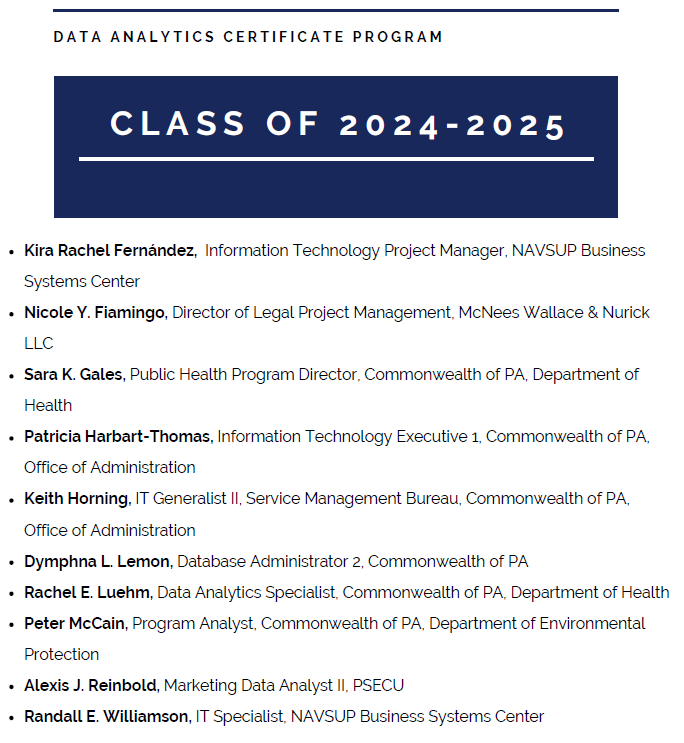
Recent Graduates

Data Analytics Certificate Program – Class of 2024/2025

Graduation Date: May 13, 2025


2026 COHORT!

If you are interested in applying for a future cohort, please email us at ProfessionalEd@HarrisburgU.edu to be added to our email list to receive announcements and updates.

Format & Location:

The 2025-2026  Data Analytics Certificate Program will be delivered  VIRTUALLY*, via Microsoft Teams – with live presenters and facilitators.

*While we are planning an all-virtual format, there may be a potential opportunity for a few select in-person networking opportunities throughout the program, for those who are able to attend in-person at Harrisburg University.

Apply Now


Application deadline: Friday, April 17, 2026

  • All applications and nomination letters are due by this date.
  • See the “Application Process” above for detailed information.

Application Status Notification: Friday, April 24, 2026

  • All applicants will be informed whether or not they have been accepted into the program.

2026 Class Schedule

  • All sessions are held Virtually via Microsoft Teams
  • All sessions are held in Eastern Time
  • Please plan to log into the Teams link 15 minutes prior to the start time of each class

**PLEASE RESERVE ALL CLASS DATES ON YOUR CALENDAR; YOU WILL RECEIVE A CALENDAR INVITE WITH THE MICROSOFT TEAMS LINK FOR EACH SESSION AS THE DATE APPROACHES**

Module #/TopicDayDateTime
Module 0
Orientation
MondayMay 4, 20262:30 pm – 3:30 pm
Module 1
Introduction to Business and Data Analytics
Monday
Tuesday
May 11, 2026
May 12, 2026
1:00 pm – 4:00 pm
9:00 am – 4:00 pm
Module 2
Descriptive Analytics: Nature of Data, Statistical Modeling and Visualization
Monday
Tuesday
June 15, 2026
June 16, 2026
1:00 pm – 4:00 pm
9:00 am – 4:00 pm
Module 3
Business Intelligence and Data Warehousing
Monday
Tuesday
July 13, 2026
July 14, 2026
1:00 pm – 4:00 pm
9:00 am – 4:00 pm
Module 4
Predictive Analytics
Monday
Tuesday
August 17, 2026
August 18, 2026
1:00 pm – 4:00 pm
9:00 am – 4:00 pm
Module 5
Prescriptive Analytics
Monday
Tuesday
September 21, 2026
September 22, 2026
1:00 pm – 4:00 pm
9:00 am – 4:00 pm
Module 6
Exploratory Data Analysis & Data Mining
Monday
Tuesday
October 26, 2026
October 27, 2026
1:00 pm – 4:00 pm
9:00 am – 4:00 pm
– Capstone Project Presentations
– DACP Program Year in Review Class Exercise
– DACP Class of 2026 Graduation
Monday
Tuesday
November 9, 2026
November 10, 2026
9:00 am – 4:00 pm

**Module topic and the order in which they are presented may change depending on speaker availability.

ADA Statement: HU is committed to providing equal education opportunity and full participation for persons with disabilities. It is HU’s policy that no qualified person be excluded from participating in any HU program or activity, be denied the benefits of any HU program or activity, or otherwise be subject to discrimination regarding any HU program or activity. Should you potentially require an accommodation under the ADA to participate in this program, please email ProfessionalEd@HarrisburgU.edu. Please send your request for an accommodation at least 5 business days in advance of the event or program.